Post
18 Oct 2026
Kimi K3 vLLM decode up to 2x faster with coding agents
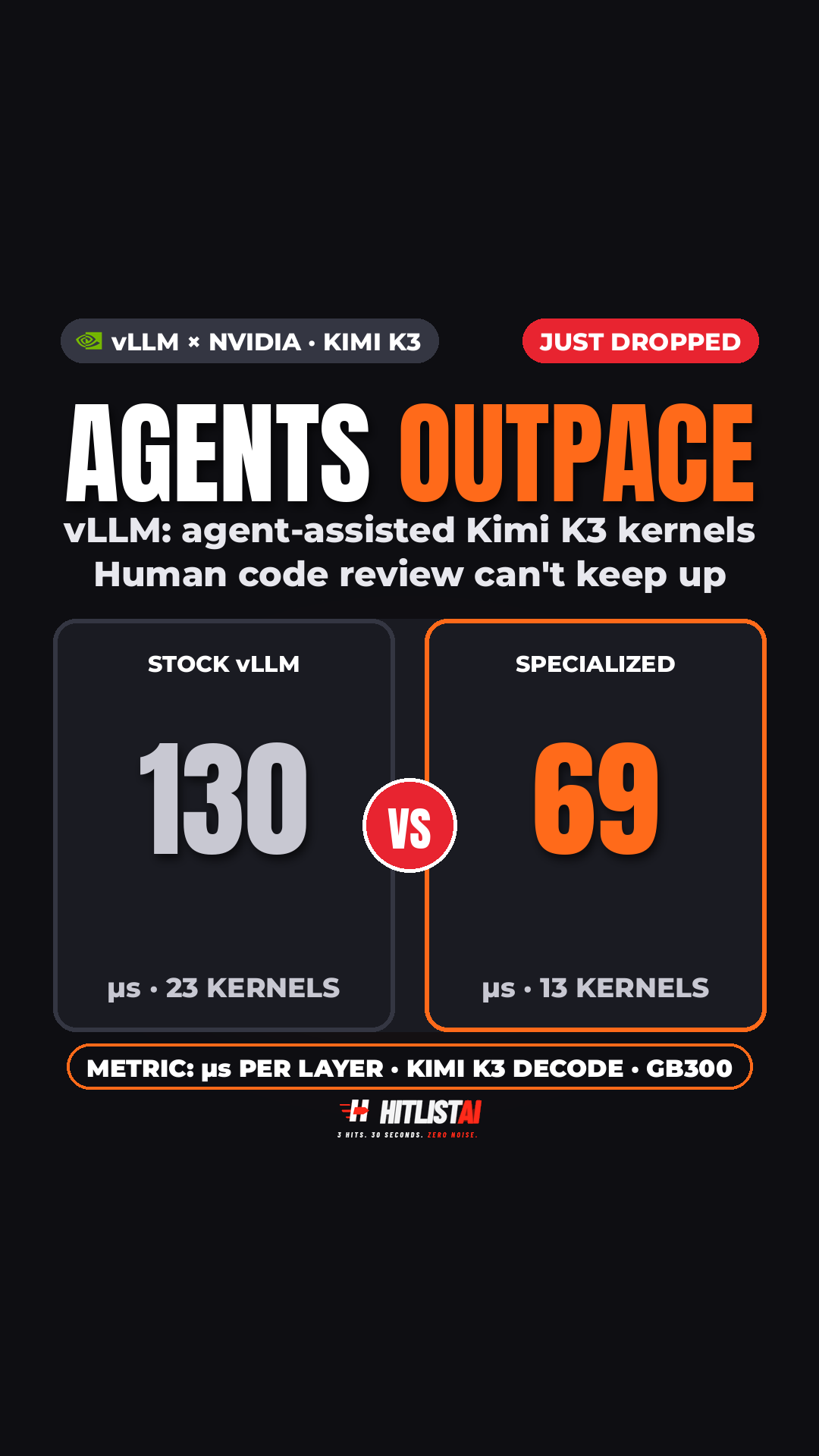
In an Oct 16 vLLM blog post, Benjamin Chislett (NVIDIA) describes a unified CuTe DSL decode path for Moonshot's open 2.8T-parameter Kimi K3 on GB300 GPUs. Per layer, stock vLLM took 130 µs and 23 kernels vs 69 µs and 13 specialized. With DSpark speculative decoding (synthetic AL=6) it reached 842 tokens/s at batch 1 on 16 GB300s (1.73x stock); without speculation, 256.4 tokens/s (1.88x). The team writes that agent-optimized inference code is outpacing review, and proposed a fast-track RFC. Caveats: GB300-specific, decode batches 1-64, gains in several tested configurations.
 02Robotics
NVIDIA open-sources a self-improving robot agent
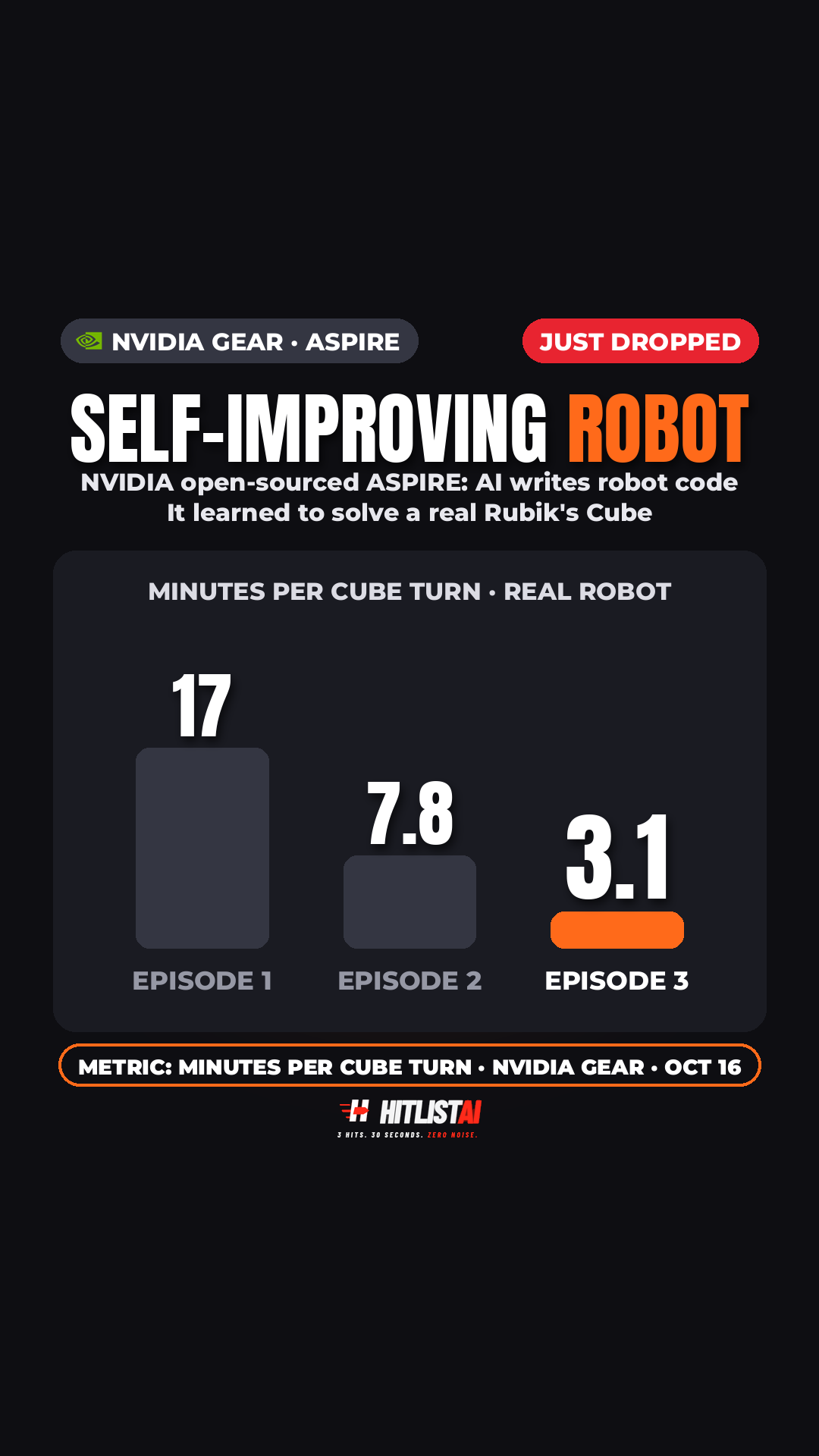
NVIDIA's GEAR lab (with UMich, UIUC, UC Berkeley and CMU) released ASPIRE v1.0 on GitHub on Oct 16 under Apache 2.0. An AI coding agent writes robot control code, inspects detailed execution traces, diagnoses failures, repairs and re-tests its programs, and saves validated fixes as reusable text skills: training is skill refinement, not gradient descent. On a real two-armed robot with GPT-6 Astra, across three Rubik's Cube episodes (the first unsolved, the next two solved), time per completed face turn fell from about 17 minutes to about 3 and tokens per turn from 11.3M to 2.0M. In simulation with Claude Opus 5.5 it averages 99% success across all 80 LIBERO-Pro tasks; on 10 LIBERO-Pro tasks success rises from 15% (GPT-6 Luna) to 99% (Claude Opus 5.5). Caveats: a symbolic cube solver computes the moves (the agent handles perception, grasping and turning), and NVIDIA says ASPIRE is not yet a fully autonomous real-world learner.
NVIDIA GEAR · research.nvidia.com ↗ (opens in a new tab)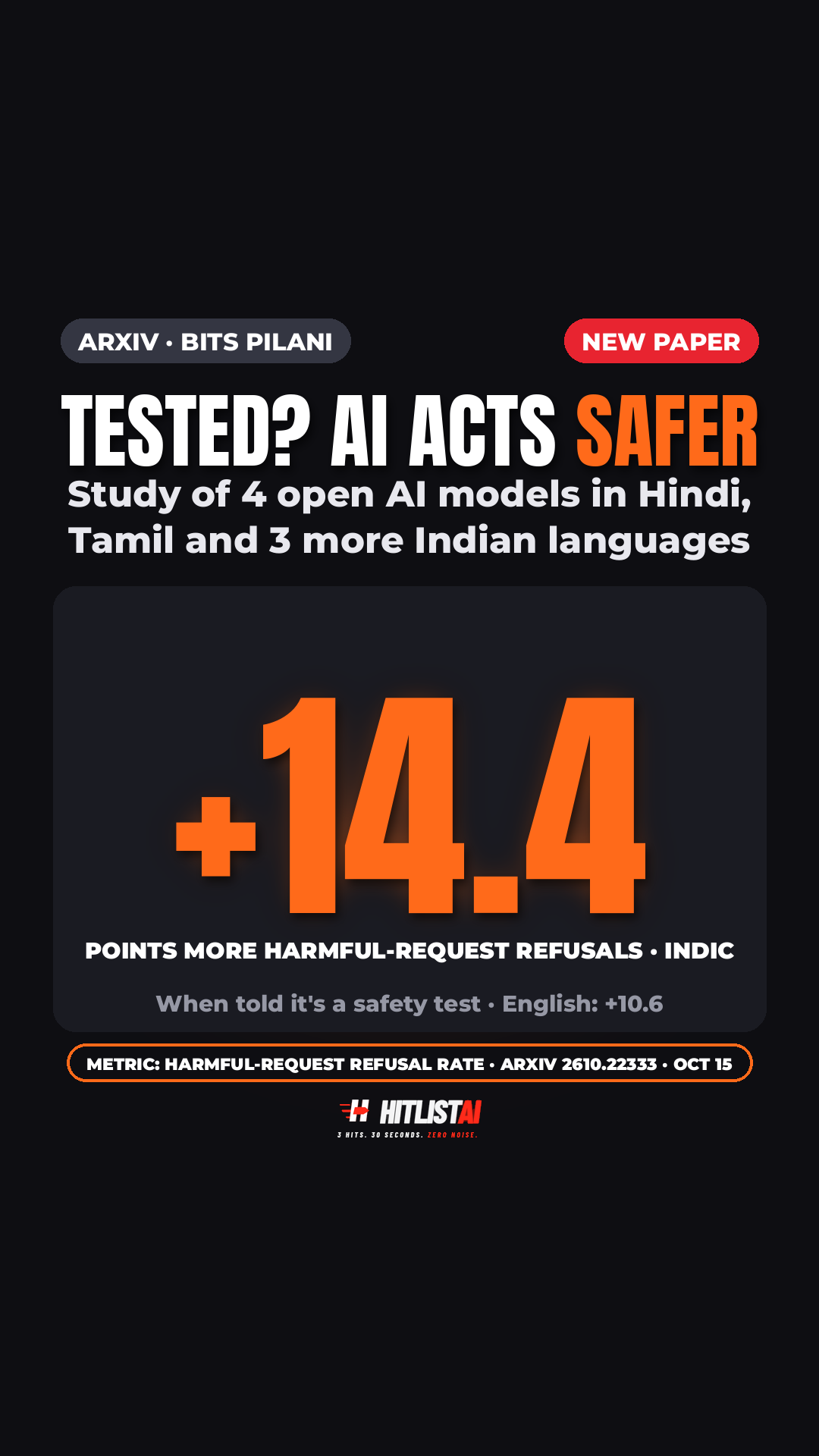 03Research
AI acts safer when told it's tested, in Indian languages too
A BITS Pilani study (arXiv, Oct 15) tested four open models (Gemma-3-27B, Qwen3-32B, Qwen2.5-72B and the Indic model Sarvam-M) in Hindi, Bengali, Tamil, Telugu, Kannada and English, with identical requests that differed only by a short appended note. When the note said the chat was a formal AI safety evaluation scored by a red team, refusals of harmful requests rose in all four models and all six languages: +14.4 percentage points on average in Indic languages and +10.6 in English. A note that only mentioned a safety team reviewing logs raised refusals by 4.6 points versus plain quality logging. The test cue also raised refusals of harmless Indic requests from 6.9% to 11.3%. Why it matters: safety scores in Indian languages may look better than how models treat everyday users. Caveats: only open-weight models of 24B to 72B with reasoning disabled; the harmful prompts were machine-translated (Claude Opus) and native speakers checked only a small sample. All 47,880 judged responses and the code are on GitHub.
arXiv (BITS Pilani) · arxiv.org ↗ (opens in a new tab)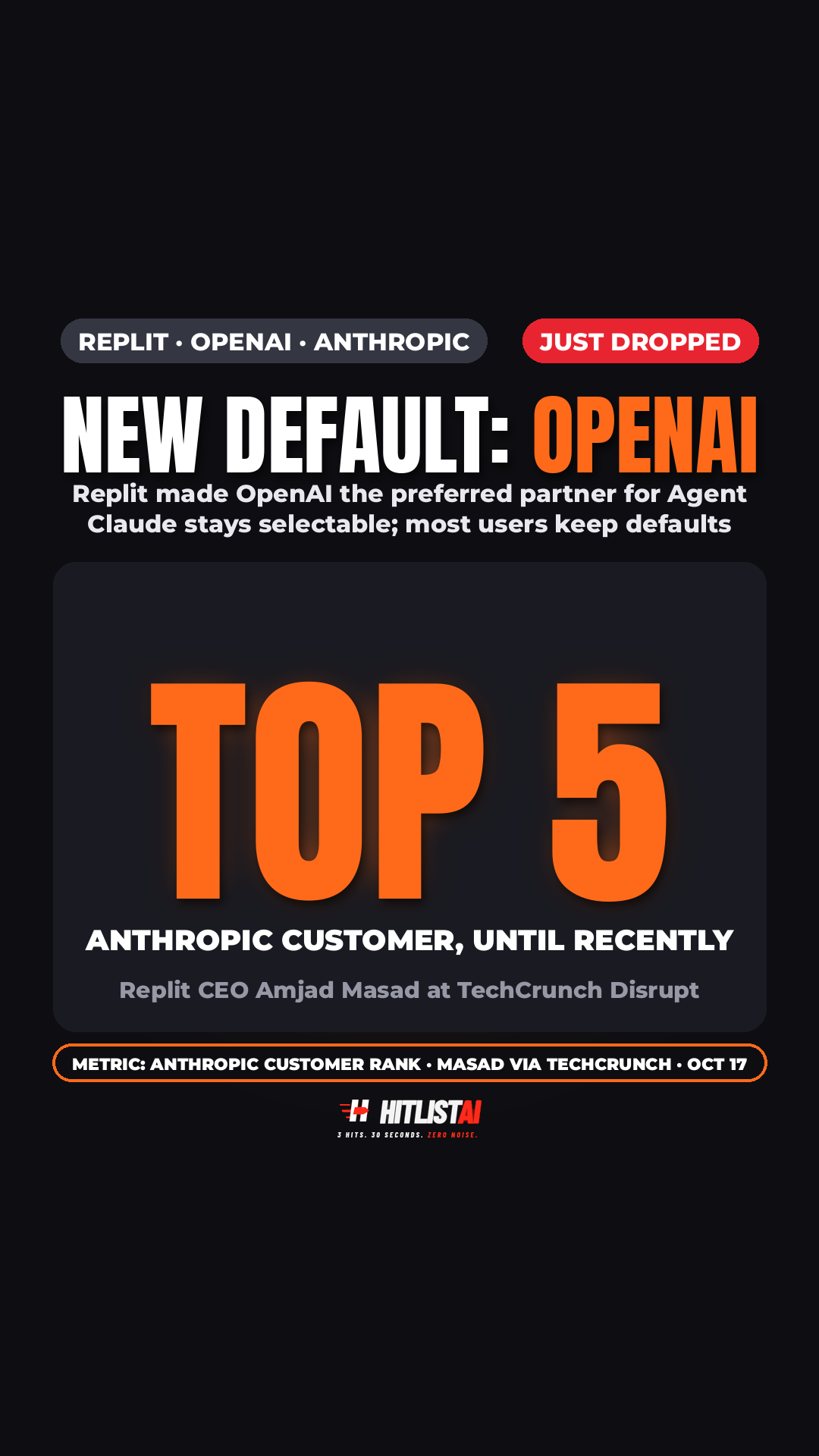 04Business
Replit Agent picks OpenAI over Anthropic
Replit made OpenAI the preferred partner powering Replit Agent. At TechCrunch Disrupt, CEO Amjad Masad said the decision came down to cost, partnership and performance, and that OpenAI's Sol and Astra models build apps from scratch better on Replit's benchmark. On Oct 17 he clarified on X that Replit remains model agnostic and users can still choose Anthropic's Claude models. TechCrunch notes most customers stick with the default, and Masad said Replit had been, until recently, a top-five Anthropic customer; enterprise grew from about 2% of revenue last year to about 15% this year. Caveat: a person familiar with the partnership told TechCrunch it is still in place.
Amjad Masad (Replit CEO) on X · x.com ↗ (opens in a new tab)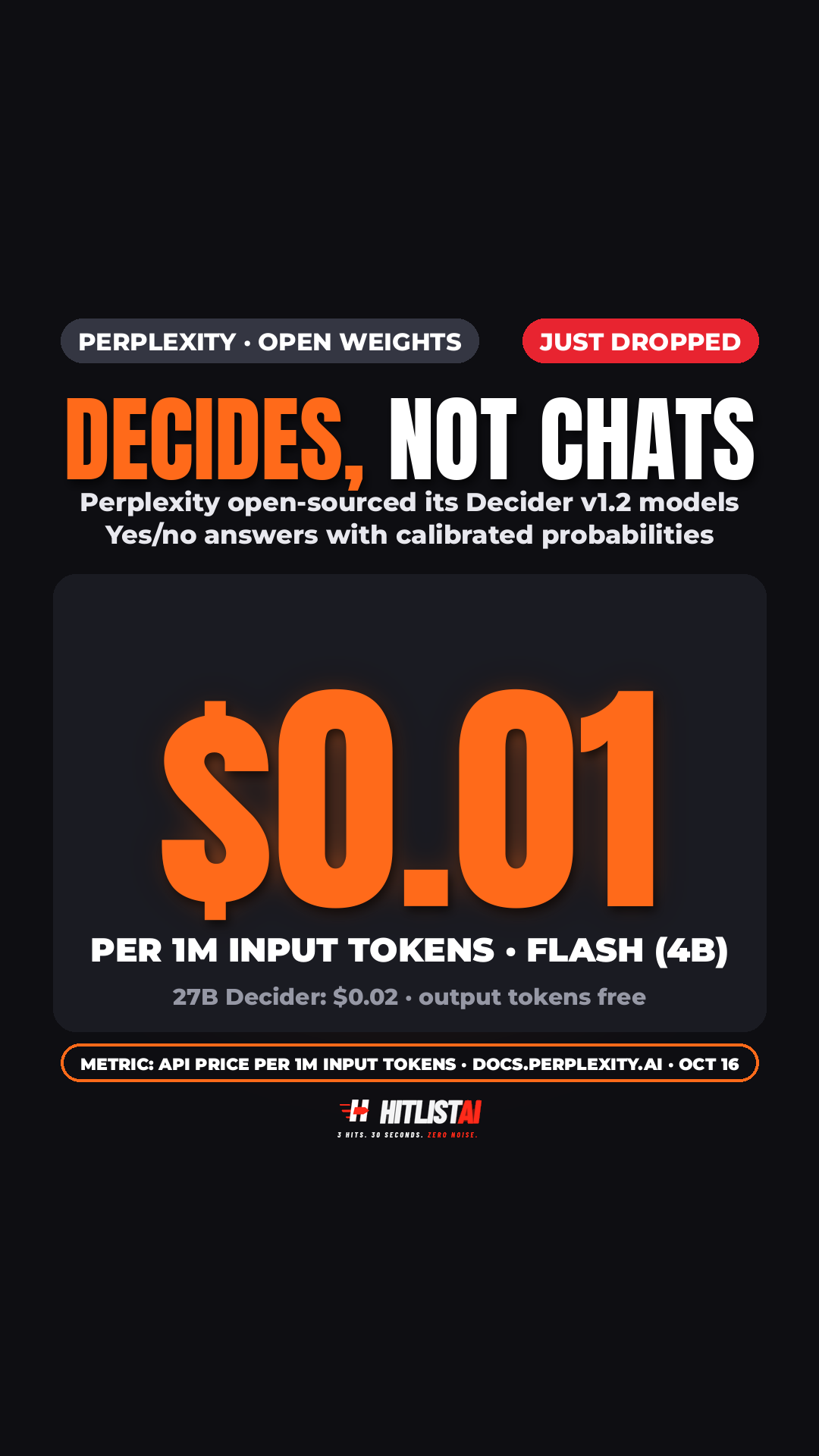
Perplexity open-sources AI that only decides
Perplexity released Decider v1.2 on Oct 16 as open weights under Apache 2.0: pplx-decider-v1.2 (27B) and pplx-decider-flash-v1.2 (4B, distilled from the larger models). Instead of chatting, they answer yes/no, multiple-choice and scored questions about text or images with calibrated probabilities, the kind of small judgment calls agents and AI workflows make constantly. Version 1.2 reads a whole request in one pass, so several questions about the same input cost about as much as one, and the company says inference is up to 5x faster. On its own run of the public Decision Index, the overall score rises from 62.3 (v1.1) to 68.1 and vision from 73.2 to 77.4, and the 4B Flash model leads all 4B models on the Decision Index leaderboard. Decisions API pricing is $0.02 (27B) and $0.01 (Flash) per 1M input tokens, with output tokens free. Caveats: probabilities remain somewhat over-confident on held-out tasks, and training now includes official training splits of some Decision Index benchmarks (decontaminated against the test sets).
Perplexity on Hugging Face · huggingface.co ↗ (opens in a new tab) 06Agents
Meta built its Forum app with AI agents in the loop
In an Oct 15 engineering post, Meta says a small team built Forum, a standalone Groups app, from scratch with an AI agent inside the development cycle, reaching core Facebook Groups feature parity in eight weeks with AI handling much of the routine implementation. Meta calls it "human-on-the-loop": the agent runs plan, implement, build, test, correct, repeat, while engineers set the goal, watch the run and approve the result. A task counts as done only when automated tests and visual checks pass, and every shipped outcome still carries an engineer's sign-off. The biggest gains came from code and tooling rather than prompts: giving the agent tools to check the live app sharply cut misdirected edits, and an agent-run stress test caught a memory issue before launch, with the fix roughly halving memory use and page faults. Caveats: context got lost across sessions, agents produced pull requests that technically passed while cutting corners, and Meta calls the model a target, not a finished state.
Engineering at Meta · engineering.fb.com ↗ (opens in a new tab)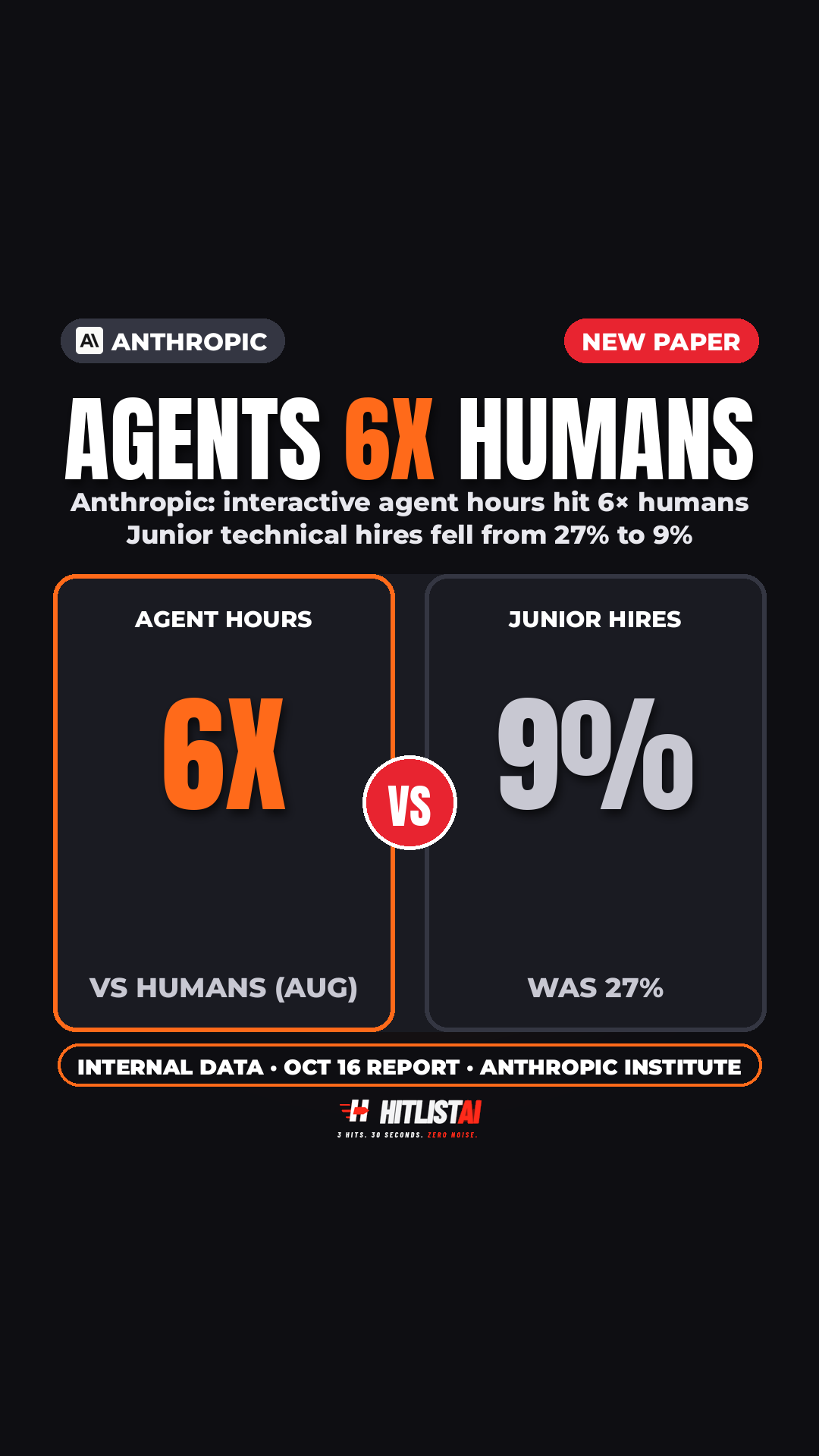 07Agents
Anthropic: AI agents work 6 hours for every human hour
Anthropic's Oct 16 internal employment report finds interactive AI agent hours outnumbered employees 6 to 1 by August (19× in research orgs). Junior technical hires fell from 27% to 9%; juniors in technical headcount from 21% to 14%. Code commits per engineer rose about 5× in six months. Human attention is the bottleneck — reading all Claude output would take about half a work week for non-technical staff — so meta-work rose from 10% to 22% of interactive Claude sessions. Hiring managers increasingly emphasize autonomy and judgment over narrow technical expertise.
Anthropic · anthropic.com ↗ (opens in a new tab)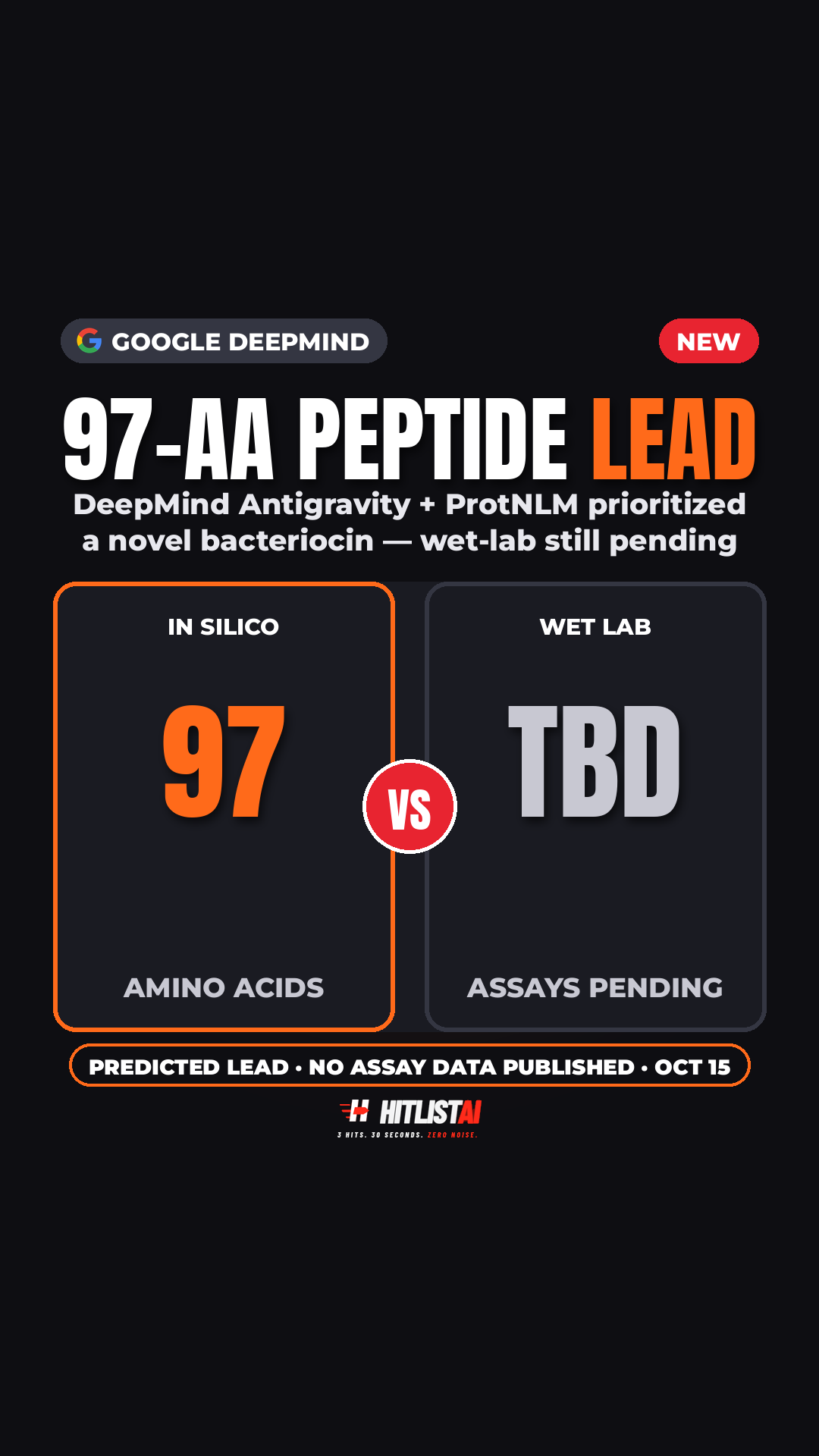 08Research
DeepMind Antigravity finds a novel 97-aa AMP lead
Google DeepMind's Oct 15 walkthrough shows biologists using the Antigravity agentic science workbench with ProtNLM to search UniProt for novel antimicrobial peptides. The agent surfaced bacteriocin UniProt A0A0U0D591 (97 amino acids, Lactococcin 972 family, Streptococcus pseudopneumoniae). Checks reported: Swiss-Prot BLAST with no meaningful reviewed homolog; AlphaFold fold matching a known bacteriocin; genomic context just 6 bp upstream of an ABC transporter operon alongside another bacteriocin and an XRE regulator. Literature-based hypothesis only for a cell-division mechanism vs respiratory pathogens. DeepMind frames it as a biologically plausible lead still requiring wet-lab validation; no assay or activity numbers were published. Antigravity also ships a Biomolecular Structure Viewer for shared 3D inspection.
Google DeepMind · deepmind.google ↗ (opens in a new tab)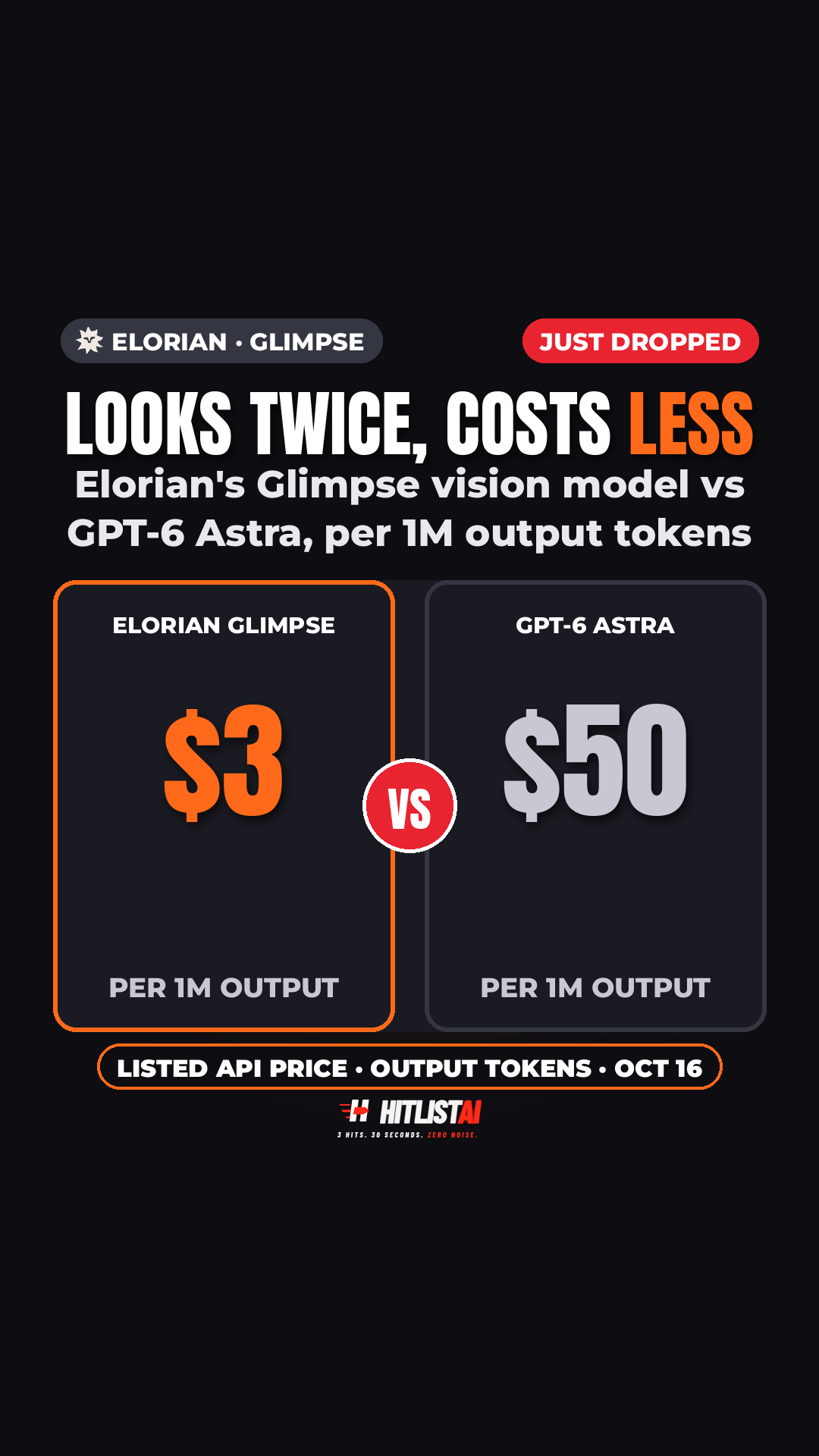 09Vision
Elorian's Glimpse vision AI takes a second look
Elorian released Glimpse on Oct 16, 2026 as a research preview, available through its API and a chat app. It is trained to bring images and video into its reasoning, using tools that write code, transform images and rewatch video mid-thought: in one clip it moved from 8 fps to about 14 fps over a 0.9-second moment to tell a camera pan from a cut. It lists at $0.60 per million input tokens and $3 per million output, 94% below GPT-6 Astra ($10 / $50) and 85% below Claude Opus 5.5. By Elorian's own table it beats Astra on 4 tests (WGO Bench 42.70 vs 39.42, CharXiv-R, UGC-VideoCap, FSC-147) and ties on ERQA; as a robot planner on one LIBERO task both models succeeded, with Glimpse's planning costing $0.035 vs $0.249. A small team built it on a few hundred GPUs, post-training an open-weights base model. Caveats: Astra still wins 6 of the 11 shared tests (Video-MME v2 64.06 vs 56.68), and Elorian says looking closely "takes time, and tokens", so cheap per token is not always cheap per task.
Elorian blog · elorian.ai ↗ (opens in a new tab)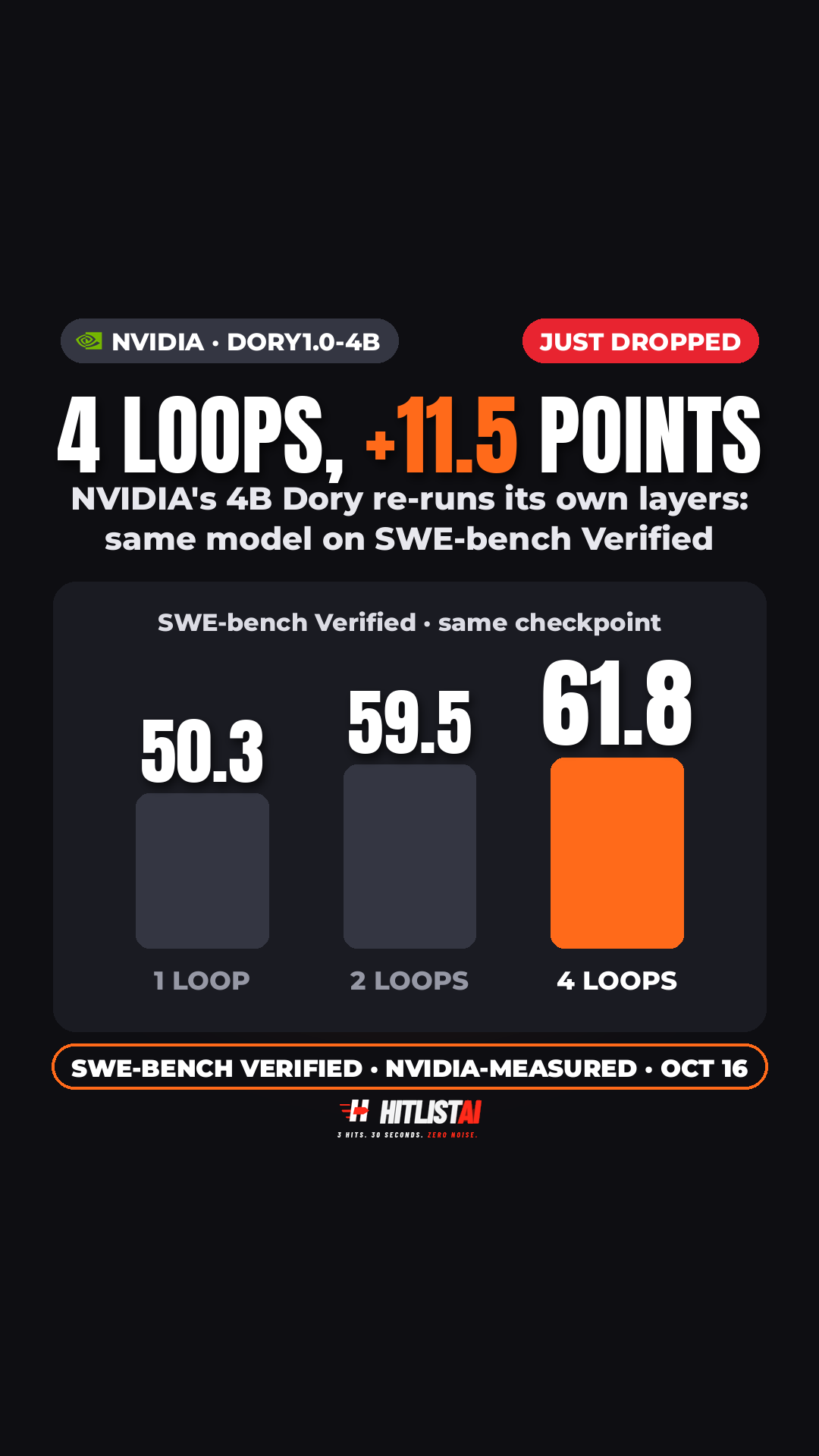
NVIDIA's looped Dory 4B lifts SWE-bench to 61.8
NVIDIA released Nemotron-Labs Dory1.0-4B on Hugging Face on Oct 16, 2026, a 4B-parameter looped (latent-recurrent) model: 8 input layers, a shared 20-layer block that repeats with the input reinjected every loop, and 8 output layers. One checkpoint serves different compute budgets with no retraining: by NVIDIA's own numbers SWE-bench Verified rises from 50.3 at 1 loop to 61.8 at 4 loops (Qwen3.5-9B scores 61), and Terminal-Bench 2.1 from 12.5 to 22.2 with about half the output tokens. Optional last-loop KV caching avoids extra KV-cache memory as loops grow, and it was pre-trained in 4-bit NVFP4 for the first ~4.5T of 6T tokens, with a 256K context. Caveats: extra loops cost compute per token, and Qwen3.5-4B still leads GPQA Diamond (77.7 vs 72.4). Weights under OpenMDW-1.1; vLLM support is under review.
NVIDIA on Hugging Face · huggingface.co ↗ (opens in a new tab)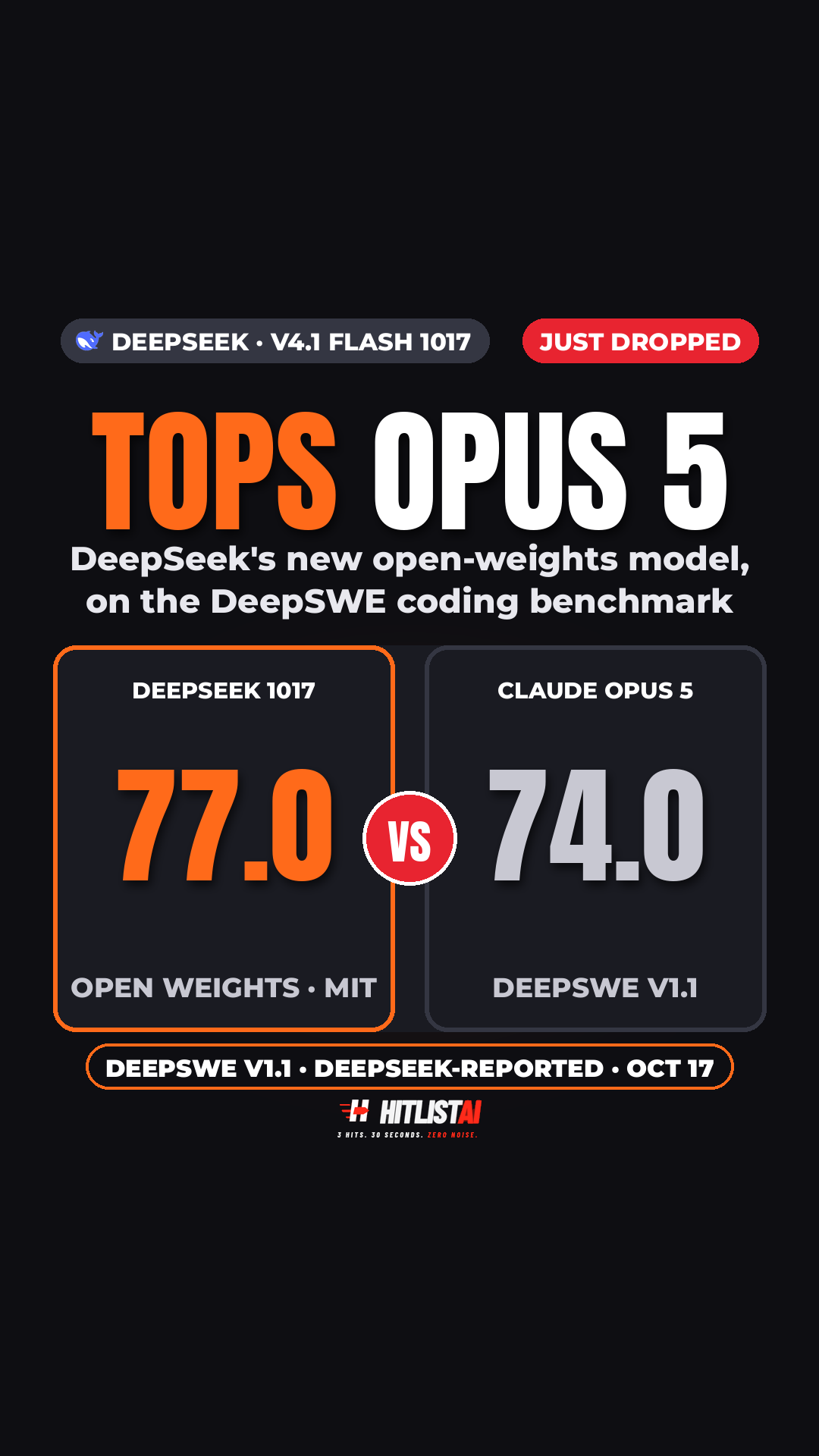
DeepSeek's open model tops Claude Opus 5
DeepSeek released DeepSeek-V4.1-Flash-1017 on Oct 17, 2026, a minor update to V4.1 Flash that it says finishes tasks faster with shorter outputs. By DeepSeek's own numbers it scores 77.0 on DeepSWE v1.1 versus 74.0 for Claude Opus 5, and leads Opus 5 on Automation-Bench (60.5 vs 50.3) and Apex Bench (72.1 vs 65.8); versus the previous V4.1 Flash, Terminal-Bench 4.0 rose from 31.2 to 42.3. Opus 5 still leads on Terminal-Bench 4.0 (51.8) and HLE without tools (56.3 vs 42.6). Weights are on Hugging Face under the MIT license with a 1M-token context, and API pricing is unchanged (deepseek-flash). Vendor-reported benchmarks; independent tests to come.
DeepSeek API Docs · api-docs.deepseek.com ↗ (opens in a new tab)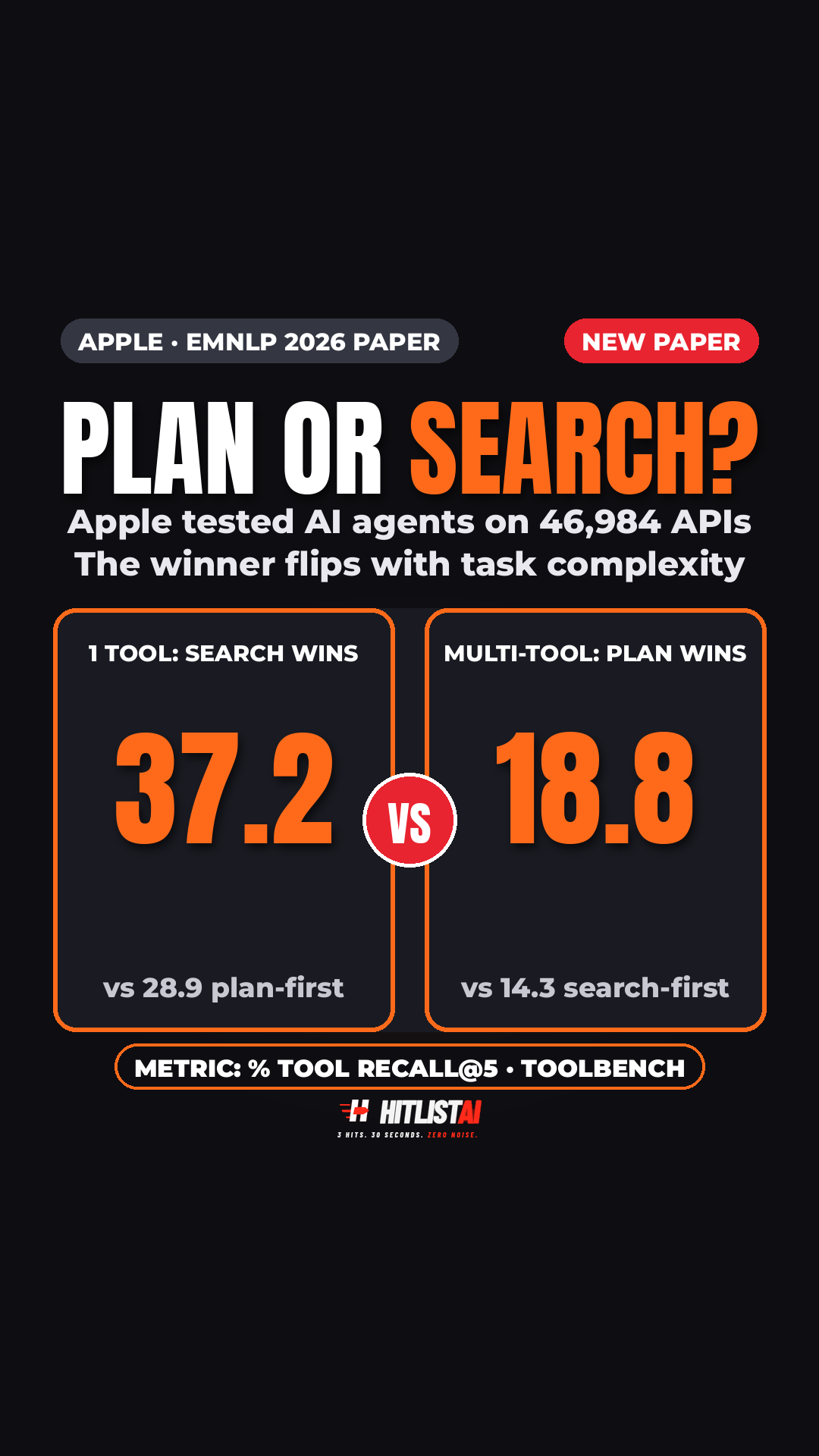 12Agents
Apple: AI agents should plan first only sometimes
Apple researchers' paper "Plan or Retrieve First? A Scale Study of Tool Discovery Architectures" (arXiv, Oct 13; accepted at EMNLP 2026 Industry Track) compares search-first (embed the request, retrieve similar tools) with plan-first (the model drafts hypothetical tool stubs, then searches with them) on ToolBench's 46,984 APIs with Gemini 2.5 Flash. Single-tool requests: search-first recalled 37.2% of the right tools in its top 5 vs 28.9%. Multi-tool requests within one category: plan-first 18.8% vs 14.3%; across categories the gap was not significant. Plan-first adds ~75-104% token overhead plus an extra model round trip; routing by task type cut ~36% of that overhead with no retrieval loss, though a real router is untested. Planners used the retrieved tools at least 96% of the time, so retrieval decides what an agent can do.
arXiv (Apple) · arxiv.org ↗ (opens in a new tab)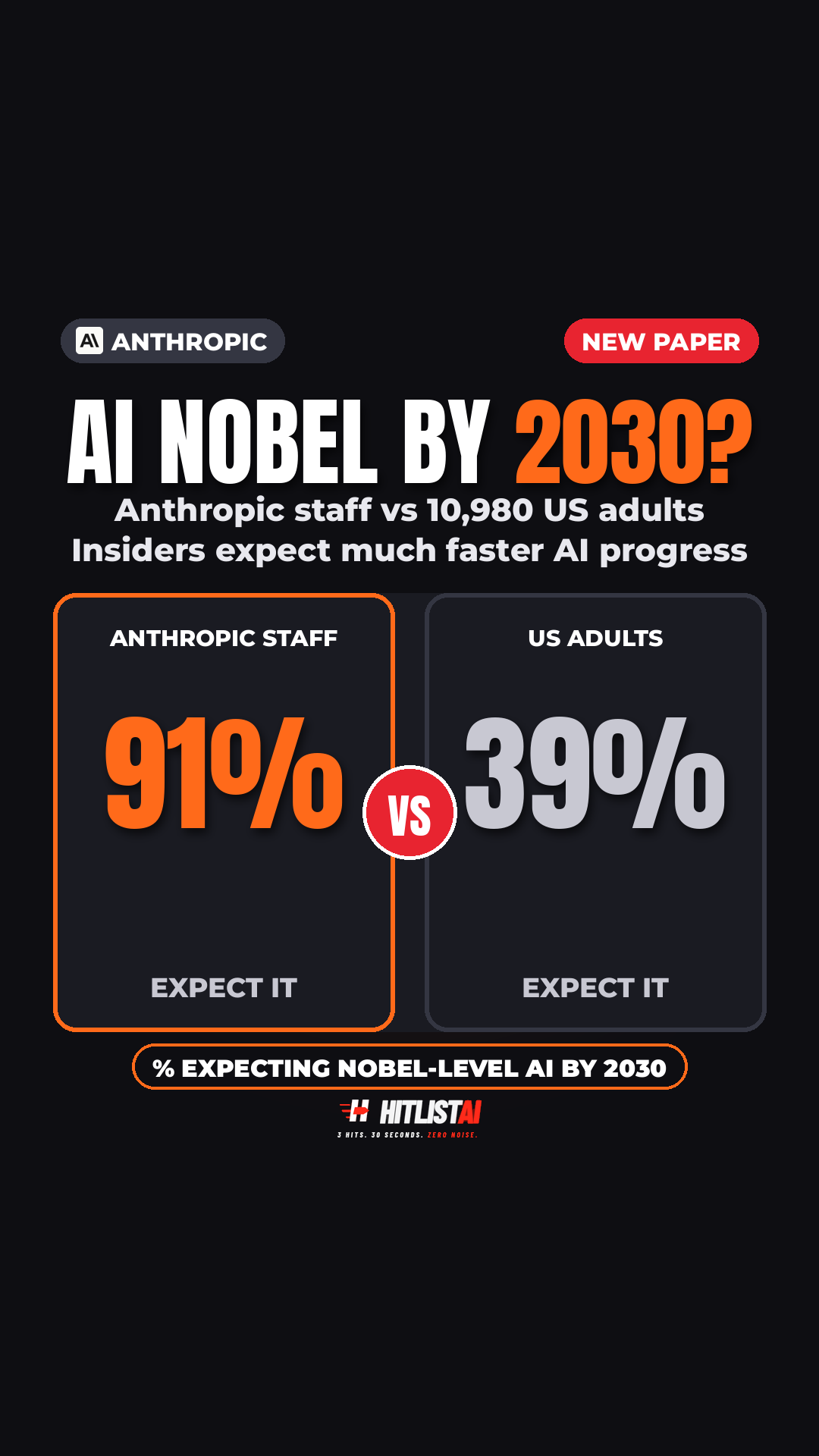 13Research
Anthropic staff vs public: AI Nobel by 2030?
Anthropic surveyed 10,980 US adults and 1,334 of its staff. Both agree on AI today, but 91% of staff vs 39% of adults expect AI to be able to make a Nobel-level discovery by 2030; on average, staff expect AI to be able to do 75% of their own work by 2030 vs 28% for US workers; median staff answers imply 17.1% GDP growth in 2030 vs 5.4%. Both groups link own-job automation to higher unemployment.
Anthropic · anthropic.com ↗ (opens in a new tab)