Post
17 Oct 2026
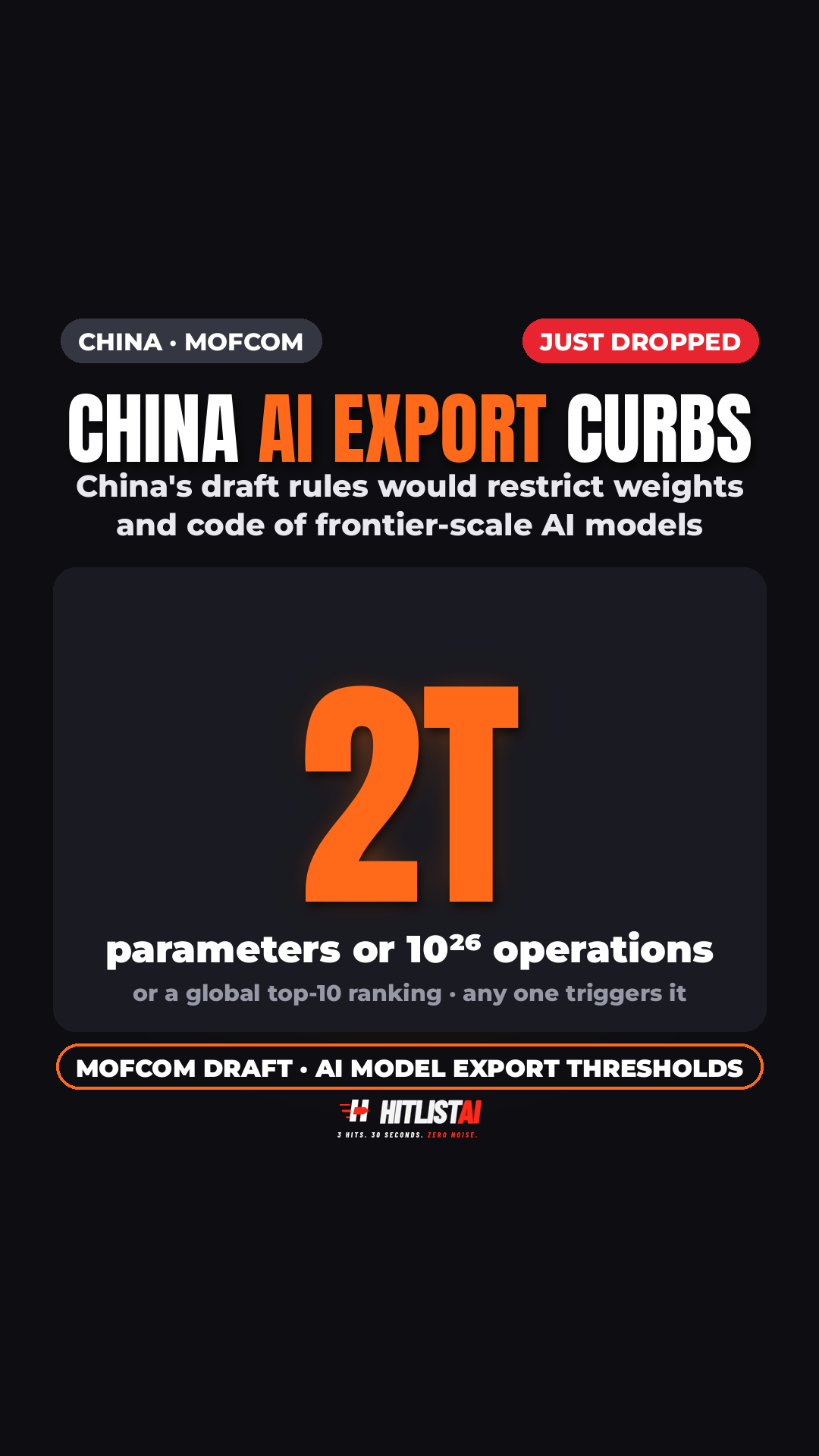
China proposes export curbs on frontier AI models
On Oct 16, China's commerce and science ministries published a draft adding 40 technologies to the country's banned and restricted export list, 23 of them in AI (large models, agents, computing clusters, information processing). A large model's core technology (weights, key checkpoints, source code, architecture) would be restricted if it meets any one test: compute of 10^26 operations or more, 2 trillion parameters or more, or a global top-10 ranking in public evaluations at the time of export. Multi-agent systems running 60+ agents at once and key tech for clusters of more than 10,000 AI accelerators are listed too. The commerce ministry says offering a restricted model through API calls, apps, websites or SaaS would not count as a technology export, but local deployment overseas would; tech already public via open source or papers is excluded, and open-sourcing restricted AI tech would get automatic licensing. Caveat: it's a draft, with public comments open until Nov 15, though exporters must register listed tech exports starting now; the ministry says most AI tech would still export freely.
 02Agents
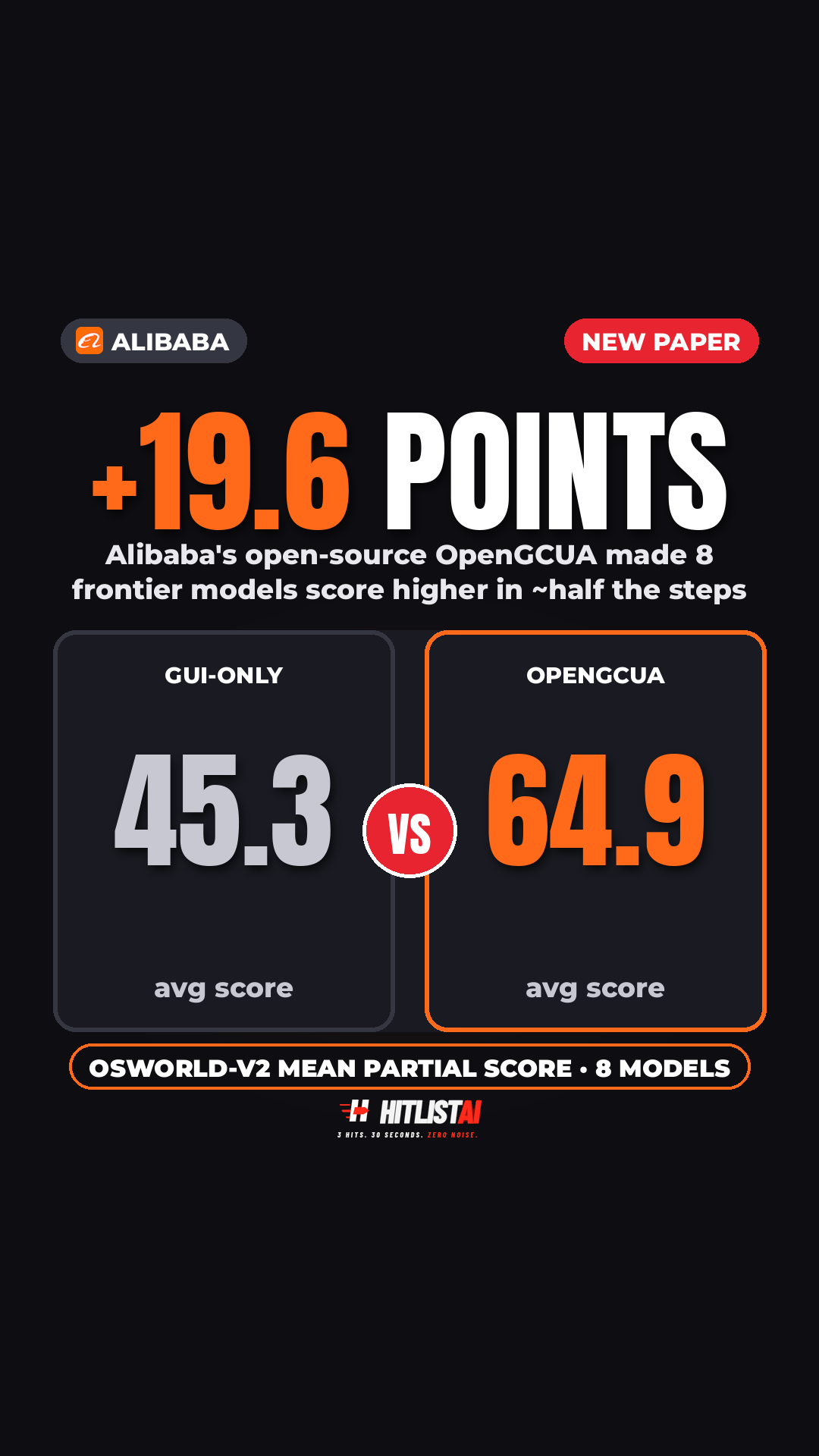
Alibaba's open agent stack lifted all 8 AI models it tested
Most computer-use agents look at a screenshot, click and repeat, while fixed rules set by developers decide what they see and remember. Alibaba researchers' OpenGCUA lets the model write code that mixes GUI clicks, accessibility-tree actions, shell commands and API calls, so each result can decide the next step, and moves decisions about what to observe (even whether to take a new screenshot) from fixed harness rules to the model. On OSWorld-v2, vs a GUI-only baseline with batched actions, the mean partial score across 8 frontier models rose from 45.3 to 64.9 (+19.6 points) with 53% fewer steps per task on average. GPT-6 Astra, the top scorer, went from 67.1 to 75.7 and cut steps per task from 102.1 to 33.5; Claude Opus 5 gained 9.4 points and cut output tokens per task from 378.3K to 89.3K. The biggest gains came from the lowest starters: GLM-5.3-Flash +35.2, DeepSeek-V4.1-Flash +29.8. Code and prompts are open under Apache 2.0, while frontier computer-use systems remain largely closed.
arXiv (Alibaba Group) · arxiv.org ↗ (opens in a new tab) 03Research
Microsoft's AI beat 6 weather centres at 2-6 week forecasts
Weather forecasts are accurate to about two weeks, then skill drops sharply 2–6 weeks out. Microsoft Research's Probabilistic Bias Correction (PBC), published in Nature, doesn't build another weather model: it learns how an existing model has been wrong in the past and corrects its new probabilistic forecasts. Applied to ECMWF's flagship, already debiased dynamical model, it improved skill for 98% of precipitation, 92% of temperature and 91% of pressure targets, and it doubled the modest 2–6 week skill of ECMWF's AI Forecasting System. In ECMWF's live 2025 AI Weather Quest, the PBC-based MicroDuet entry ranked first for every variable and lead time in the inaugural season, beating six operational forecasting centres and 34 teams; its week-4 forecast flagged a mid-December 2025 cold air outbreak in the eastern US that ECMWF's debiased model missed. Kenyan forecasters are piloting it this rainy season, and the code is open source. Caveat: the authors frame PBC as a post-processing tool, not a replacement for better weather models.
Nature (Microsoft Research) · nature.com ↗ (opens in a new tab)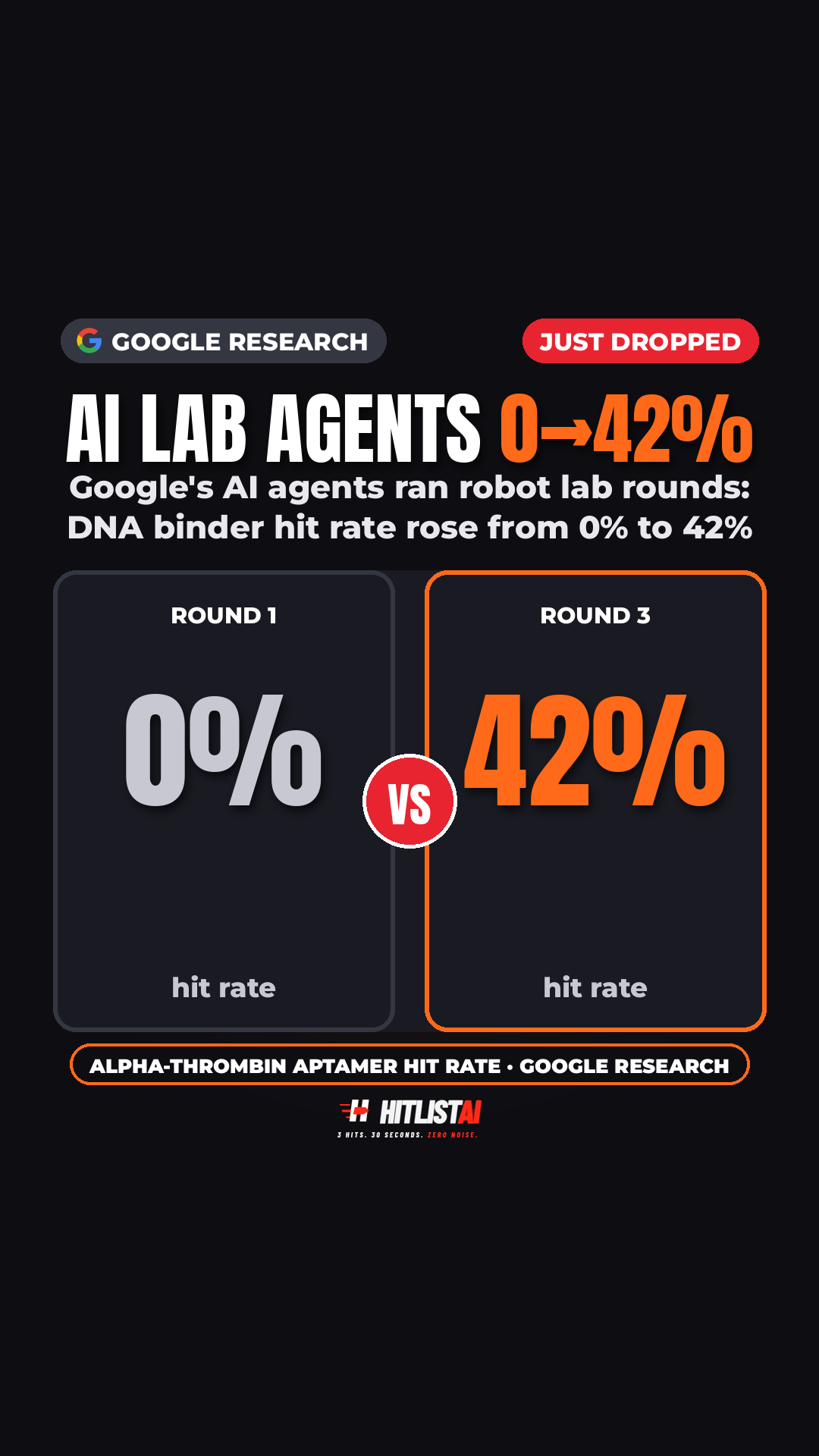 04Research
Google's AI agents ran real lab robots: binder hit rate 0% to 42.1%
Google Research grounded AI agents in VERID, a live 3D digital twin of a liquid-handling robot workcell: every protocol is dry-run in simulation and invalid commands are blocked before they reach the robot. Over 3 closed-loop design-test rounds of DNA aptamers, the alpha-thrombin hit rate went 0% → 26.0% → 42.1% (98.5% specificity). On myoglobin, agents spotted "sticky" non-specific binders, revised their own design rules and lifted the on-target hit rate ninefold to 33.5%. For FAP, a protein overexpressed in solid tumors, top designs reached single-digit nanomolar affinity in a few experimental runs. Excising just the binding pocket made each fold 8.6x faster, and at equal compute a scientist + agent nearly doubled a scientist's in-silico hit rate (9.33% vs 5.06%). Caveat: these are building blocks, not a fully autonomous lab; humans authorize designs and supervise robot runs, and every sequence gets biosecurity screening.
Google Research · research.google ↗ (opens in a new tab)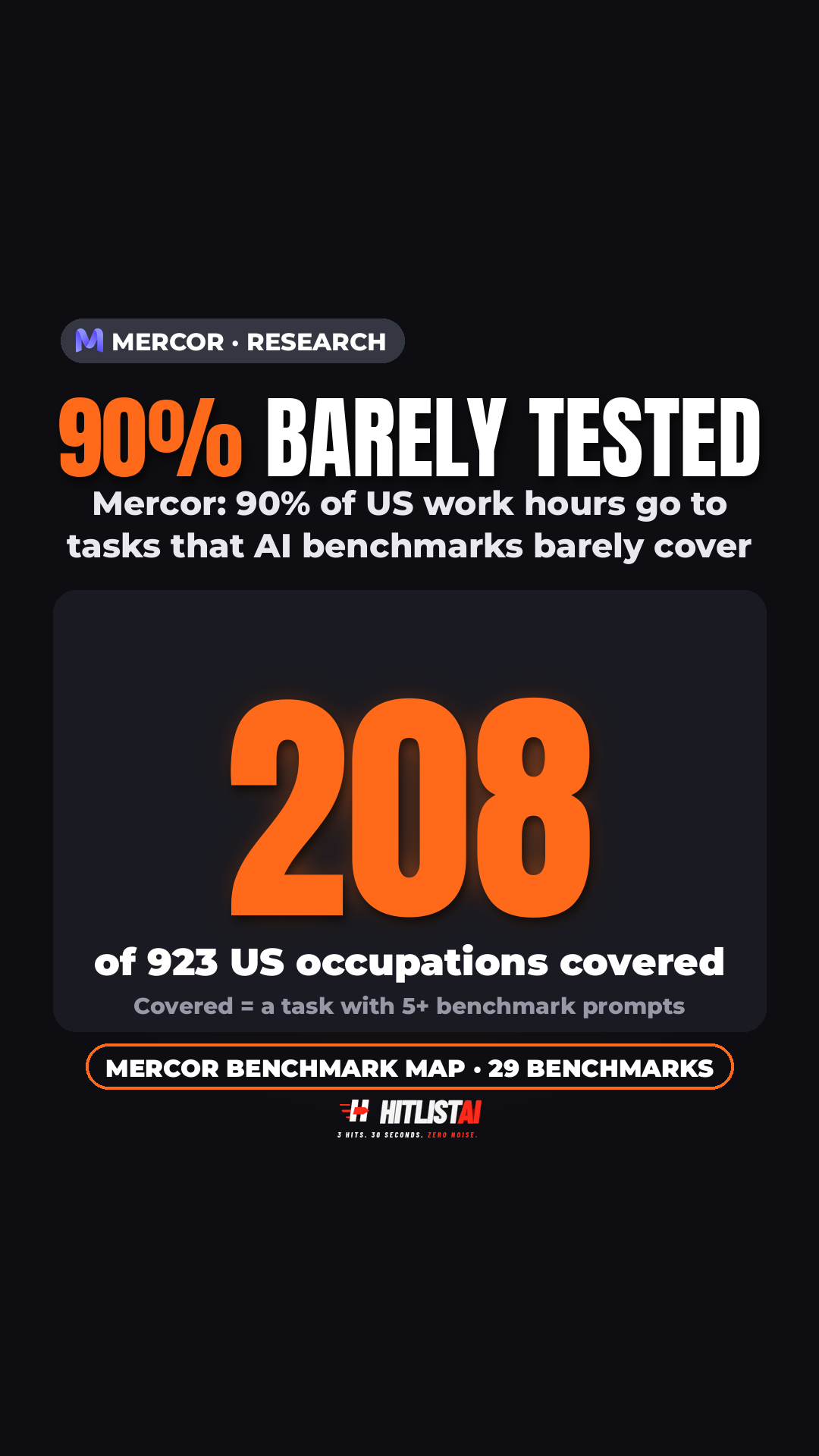 05Research
Mercor: 90% of US work hours barely covered by AI benchmarks
Mercor mapped 29 AI benchmarks onto the US Labor Department's O*NET list of 923 occupations and 18,797 tasks, using an LLM judge to tag each benchmark prompt. Its finding: 90% of American working hours go to tasks with little or no benchmark coverage. Only 208 of 923 occupations have even one task with 5+ benchmark prompts (924 of 18,797 tasks); computer & math is 29 of 36 covered, healthcare practitioners just 12 of 89, and 6 of 22 job families have none. AI-exposed tasks are about 6x more likely to be benchmarked. Caveat: Mercor calls the results provisional; they come from 29 benchmarks it chose (including its own APEX), and an incomplete list understates coverage.
Mercor · mercor.com ↗ (opens in a new tab)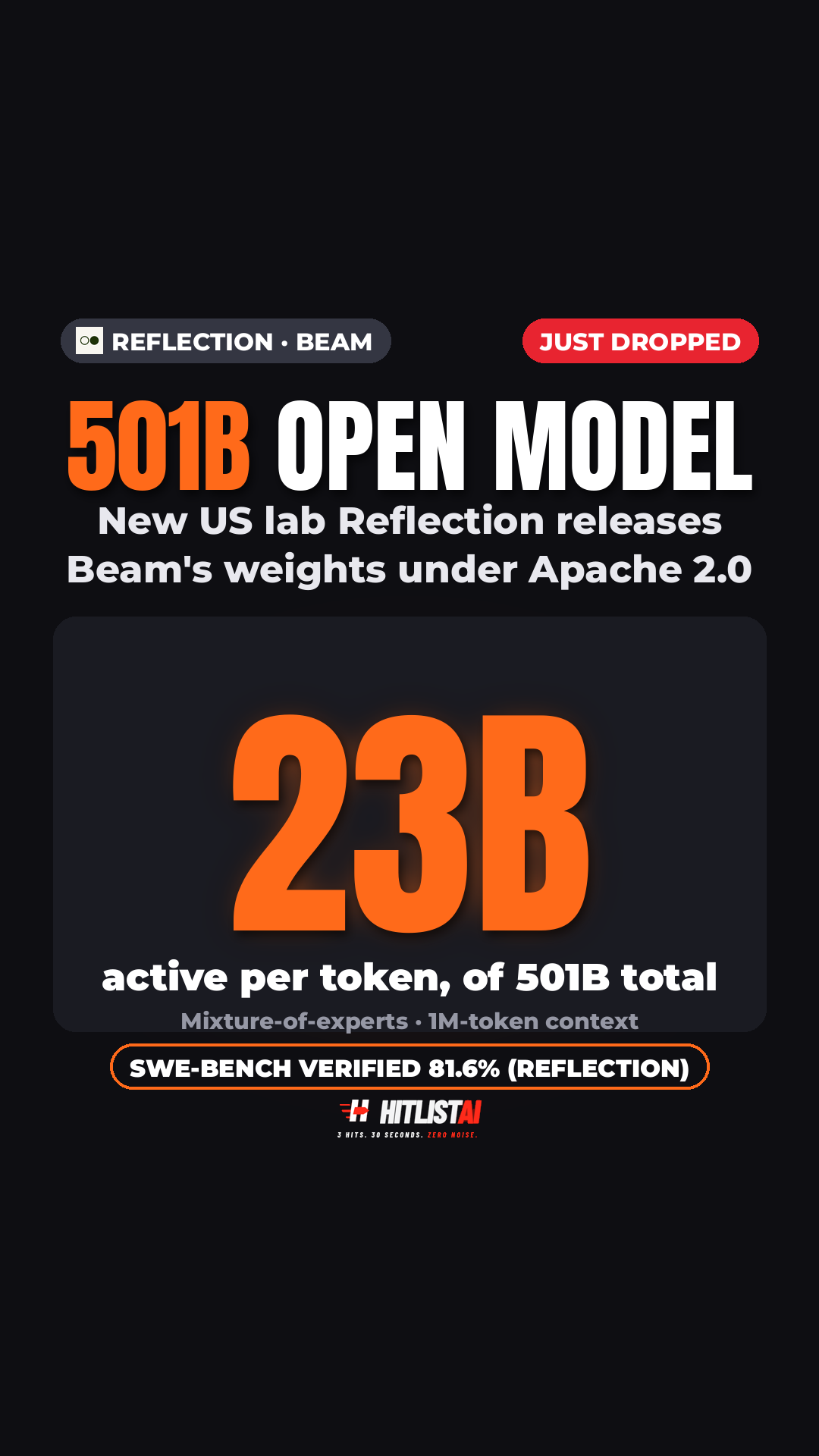
Reflection's Beam: a 501B open-weight model with only 23B active
Reflection, a new US lab, released open weights for Beam, its first open-weight model, on Hugging Face under Apache 2.0: a mixture-of-experts with 501B total parameters, 23B active per token and a 1M-token context. Built for coding and agents; Reflection's model card reports 81.6% on SWE-bench Verified and 80.1% on Terminal Bench 2.1, and says it needs ~3x fewer reasoning tokens than leading open models for comparable quality. Caveat: those are Reflection's own numbers, and even the NVFP4 checkpoint is ~280 GB (Hugging Face suggests four B200s).
Reflection · reflection.ai ↗ (opens in a new tab)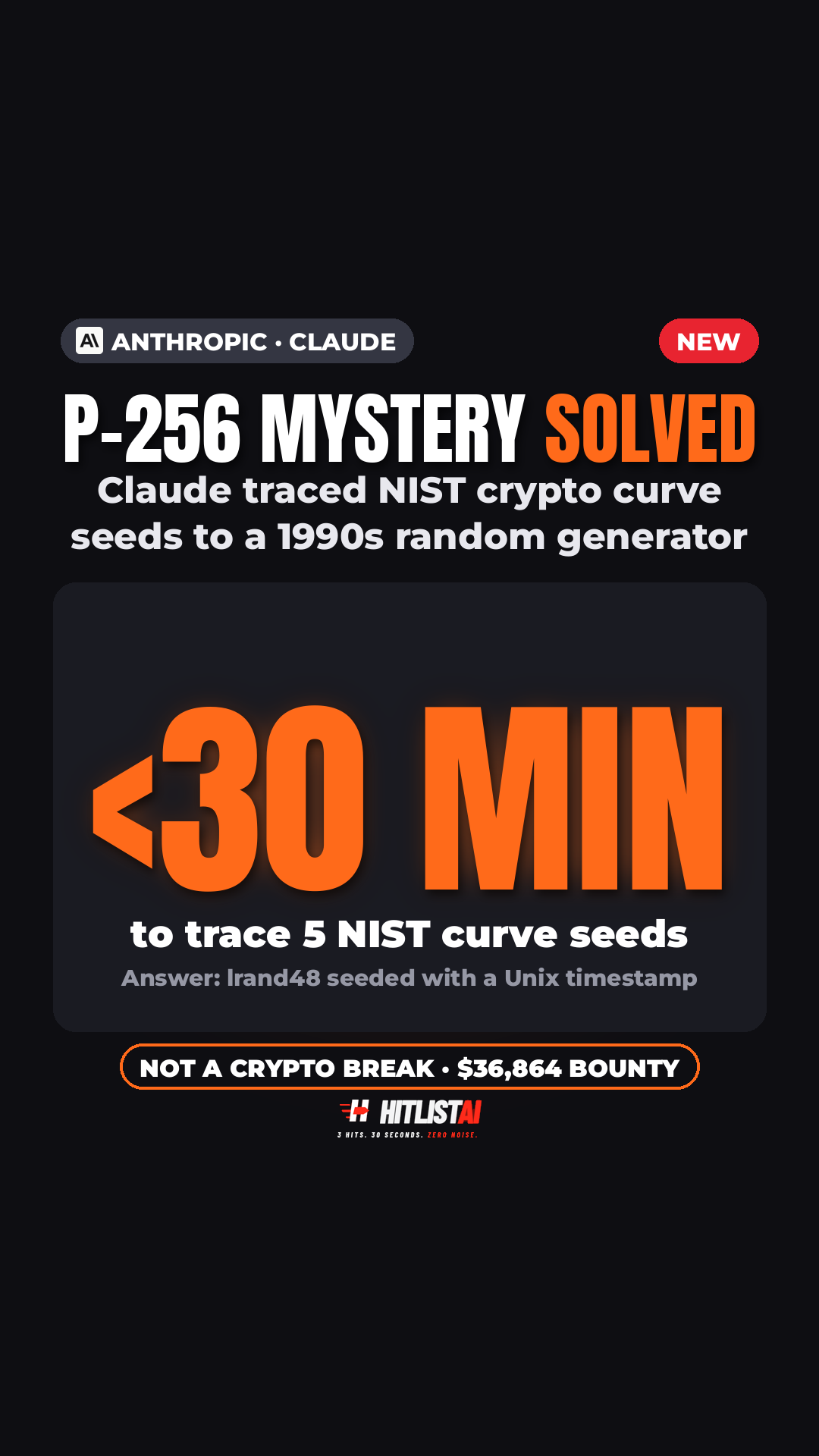 07Security
Claude traced NIST's ECDSA curve seeds to a 1990s random generator
Anthropic says Claude found that the NSA-supplied seeds for NIST P-192, P-224, P-256, P-384 and P-521 weren't a hash of a joke passphrase but output of the C library's lrand48, seeded with a Unix timestamp (P-256 = candidate 1842, 1997-08-16 UTC). Found in under half an hour; reproducible. Not a crypto break, and it makes a backdoor much less plausible. Still open: the B-163 seed and most base points. The $36,864 bounty goes to ISRG.
Anthropic · anthropic.com ↗ (opens in a new tab)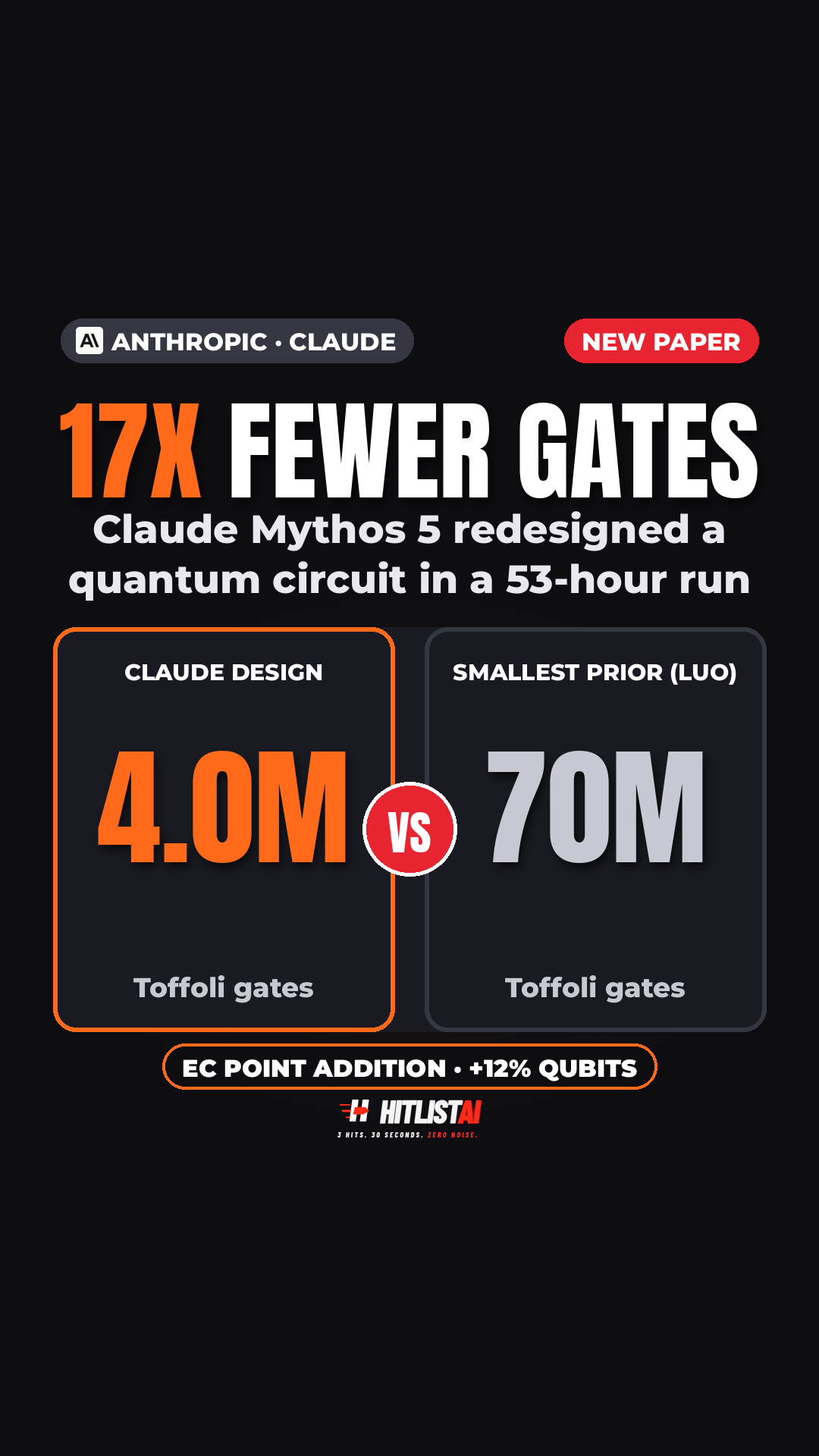 08Research
Claude Mythos 5 improved on the best published quantum circuits
Anthropic gave Claude Mythos 5 plain-language specs for 8 quantum circuits plus an automated scorer. In 7 of 8 tasks its designs cut both Toffoli gates and qubits vs the state of the art; one elliptic-curve design from a 53-hour run uses 17× fewer gates (12% more qubits), and a decoder got 12× fewer gates vs Google's previous design. Caveat: checked by a classical evaluator.
Anthropic · anthropic.com ↗ (opens in a new tab)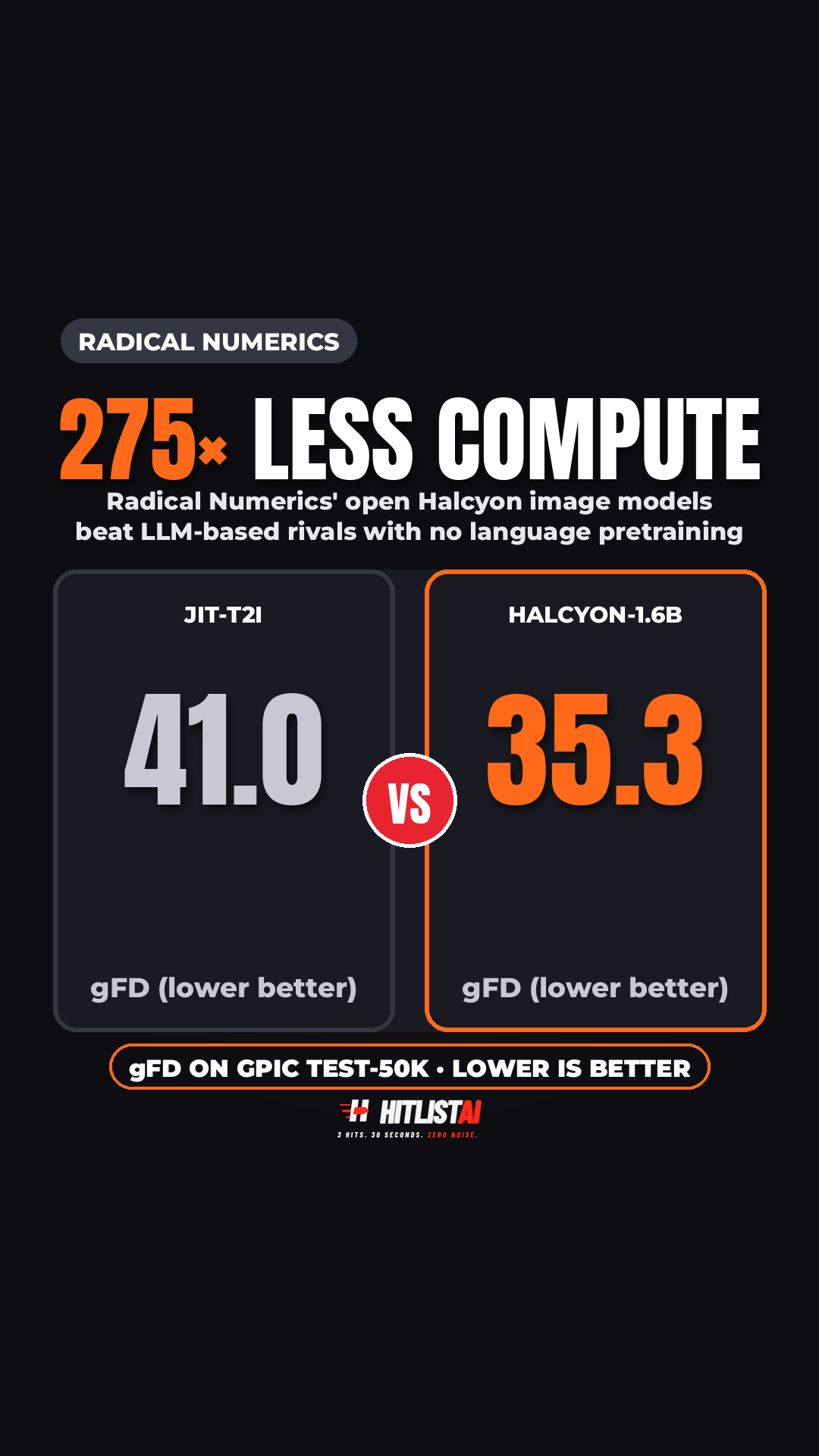 09Research
Image AI beats LLM-based rivals without language pretraining
Radical Numerics trained Halcyon, a family of open early-fusion autoregressive text-to-image models (0.1B to 4B parameters), entirely from scratch on 100 million image-text pairs, with no language pretraining. In controlled tests against baselines retrained on the same data, Halcyon-1.6B beat the JiT-T2I diffusion model (35.3 vs 41.0 gFD, lower is better) with 275x less total pretraining compute, counting the language model, image tokenizer and generator; Halcyon-0.52B beat LlamaGen (48.0 vs 63.3 gFD) with 18.2x less, and scored 44.91 vs 30.48 on GenEval. Giving 10-50% of the budget to text-only pretraining made images worse (gFD 48.0 to 51.6-65.1), and starting from a pretrained language model gave no gain. The same models also learn image captioning at no extra pretraining cost. Ten Halcyon checkpoints (5 sizes, 2 variants each) are on Hugging Face. Caveat: results are at 256x256 in the authors' own setup.
Radical Numerics · radicalnumerics.ai ↗ (opens in a new tab)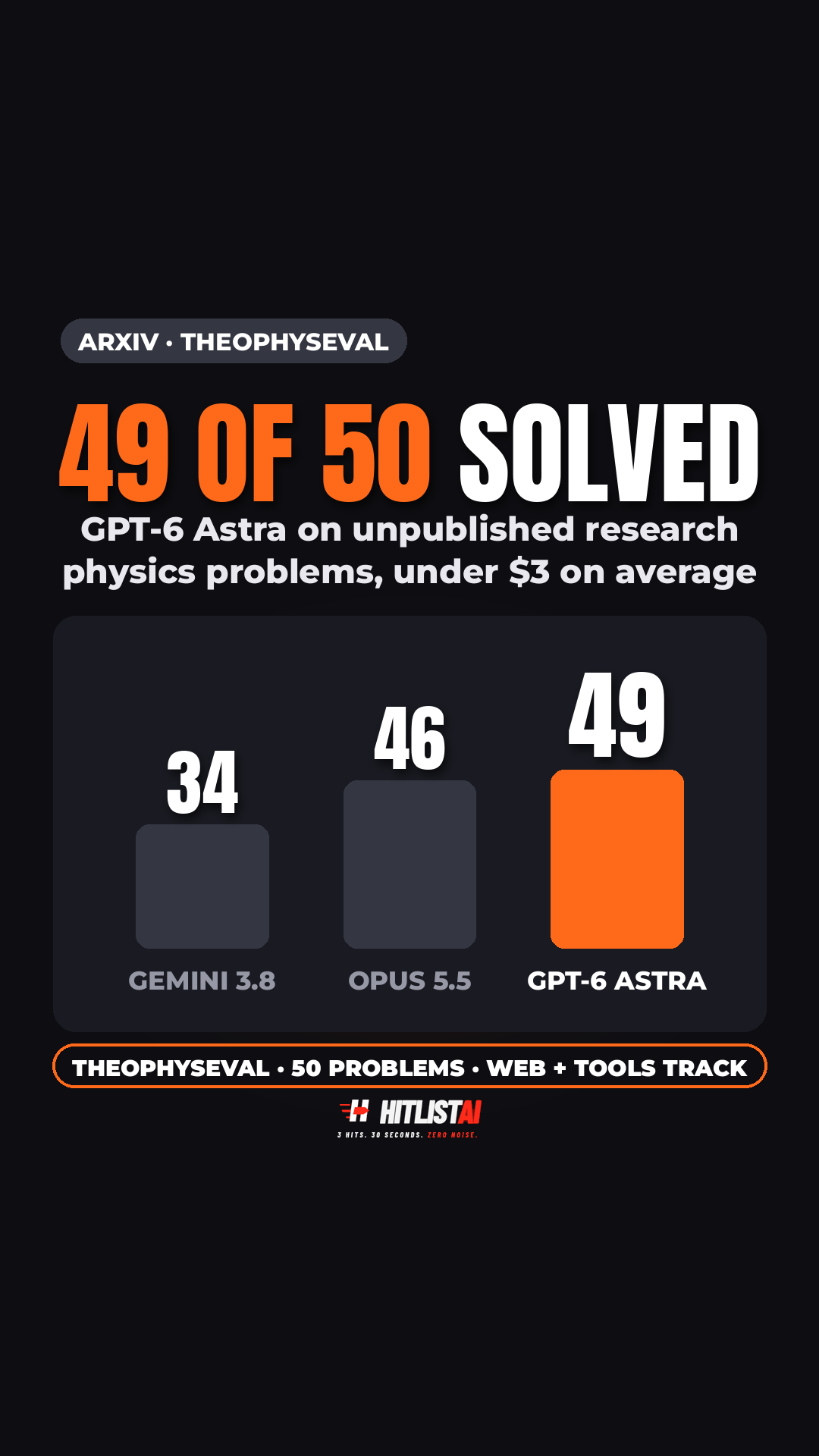 10Research
GPT-6 Astra solved 49 of 50 unpublished physics research problems
TheoPhysEval, a new benchmark from 35 researchers at ICTS, TIFR, IISc, Harvard, KU Leuven, Google DeepMind and other institutions, sets 50 unpublished, research-level theoretical physics problems; a typical one is about a day's work or less for a world expert. Off-the-shelf AI agents got web search and coding tools but no human hints. GPT-6-Astra in Codex solved 49 of 50 (98%), at under $3 per problem on average (about $116 for the full run); Claude Opus 5.5 in Claude Code solved 46, Gemini 3.8 Flash 34, open-weight DeepSeek-V4.1-Flash 27 and GLM 5.3 21. Several Astra answers first graded wrong turned out to expose subtle errors in the experts' reference solutions. With web search off, Astra and Opus still solved 46 each, which the authors read as heavy memorization of the physics literature. The authors say some frontier models may already have surpassed the best human researchers at concrete calculations. Caveat: these are "turn-the-crank" problems that extend known results, not breakthroughs; each agent ran once; and agents still lack "taste" in picking problems.
arXiv (TheoPhysEval) · arxiv.org ↗ (opens in a new tab)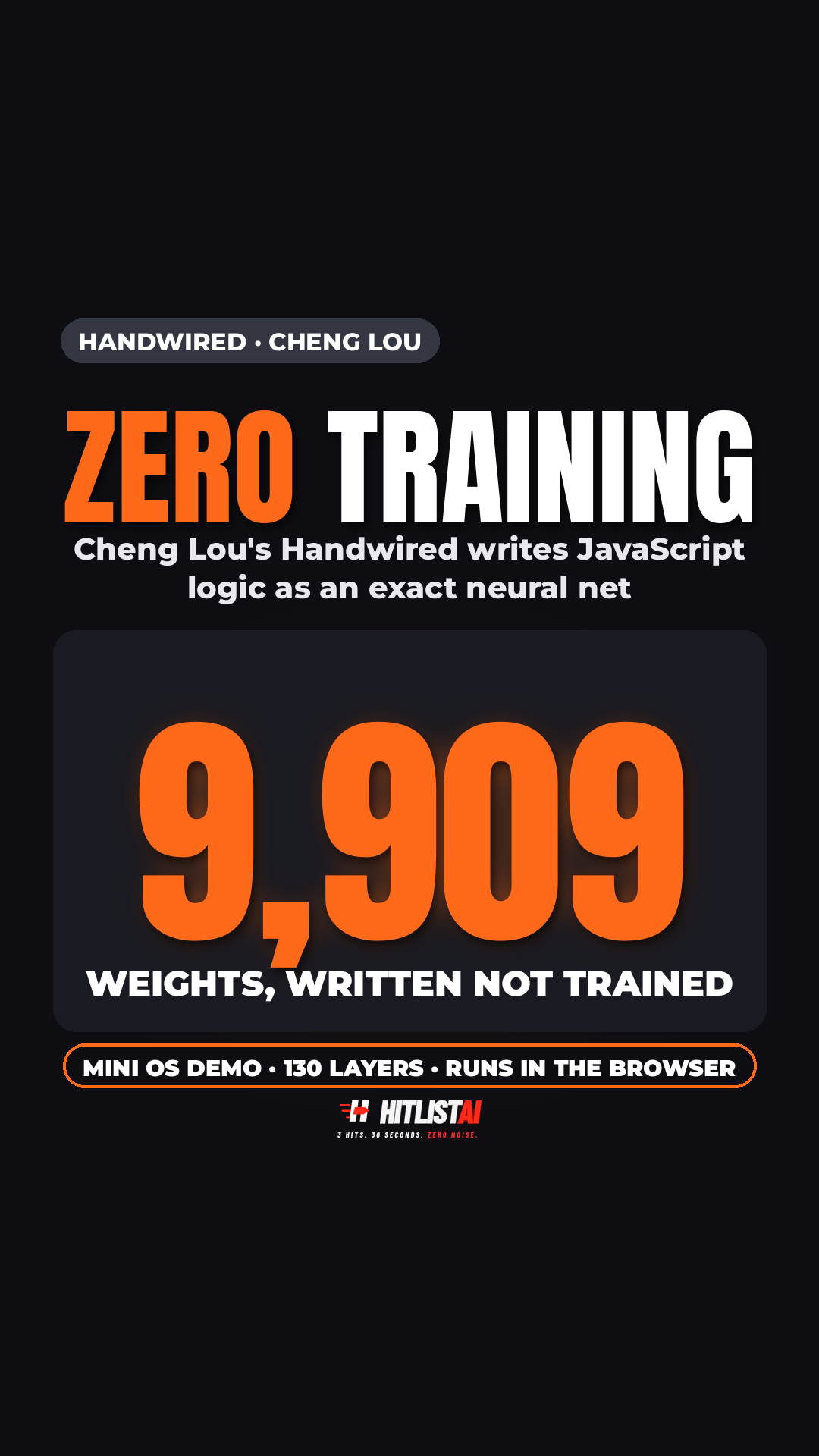 11Coding
Handwired: write JavaScript logic as a neural net, zero training
Handwired, a new MIT-licensed open-source project from Cheng Lou (released Oct 15), lets you write JavaScript logic as an exact neural net: if-else, loops and state become matrix multiplications and ReLU gates over floats, with weights written by hand rather than learned. Nothing is trained, the output is exact, and the whole program stays fully differentiable, runnable in a browser without a GPU. The flagship Mini OS demo is a small desktop with windows, dragging, scrolling and animation in 9,909 weights and 130 layers with zero training; a JSON search demo searches 100,000 documents at every keystroke with the JavaScript turned into WebGPU kernels; and a learned gallery unfreezes a program's weights and trains them in real time. The pitch: attach an exact, frozen program to a regular neural net and train end to end. Caveat: there is no automatic converter; you write the network in builder code by hand, and only the search demo runs on WebGPU.
GitHub (chenglou/handwired) · github.com ↗ (opens in a new tab)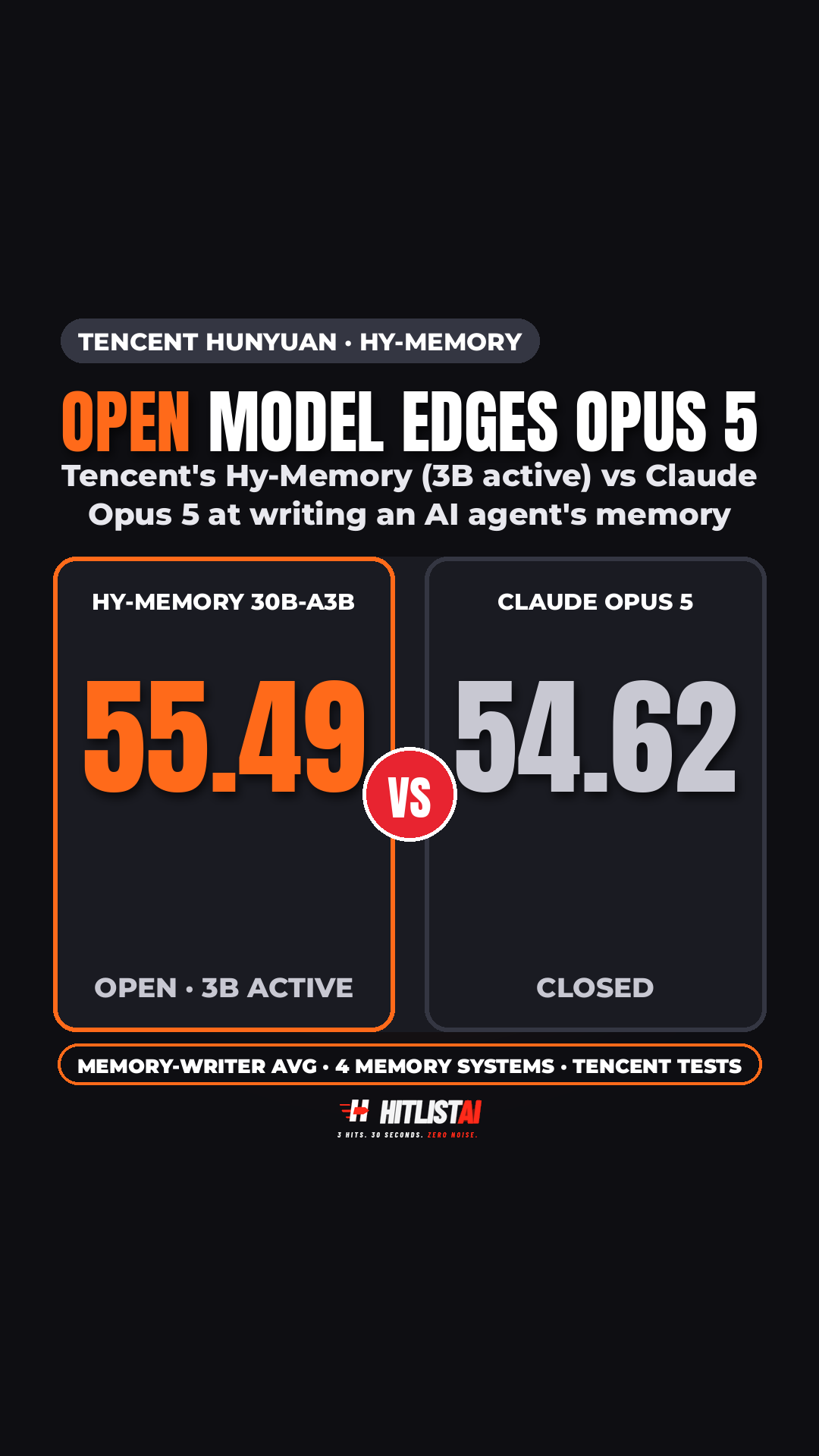 12Agents
Tencent's open memory model edges Claude Opus 5
Tencent Hunyuan open-sourced Hy-Memory-30B-A3B (Apache 2.0, paper Oct 15), a memory-writer model with about 3B active parameters that replaces the general-purpose LLM on the write path of agent memory systems like Mem0 and MemOS: deciding what to keep, how precisely to store it, and how new evidence updates the memory. In Tencent's tests across four memory systems it averaged 55.49 vs 54.62 for Claude Opus 5 and 53.64 for DeepSeek V4.1 Flash, with its biggest lead on EverMemOS, a system held out of training (56.89 vs 54.04). It was trained by distillation from Tencent's Hy3 flagship, then RL with trap questions that penalise storing junk. Also released: the Hy Memory SDK (chat, working and coding memory) and MemHub, a local-first app that shares one memory across tools like Claude Code, Cursor and Codex. Caveat: tests used fixed 20% benchmark samples, and the authors call the 0.01-0.02 point margins on two systems parity.
arXiv (Hy-Memory) · arxiv.org ↗ (opens in a new tab)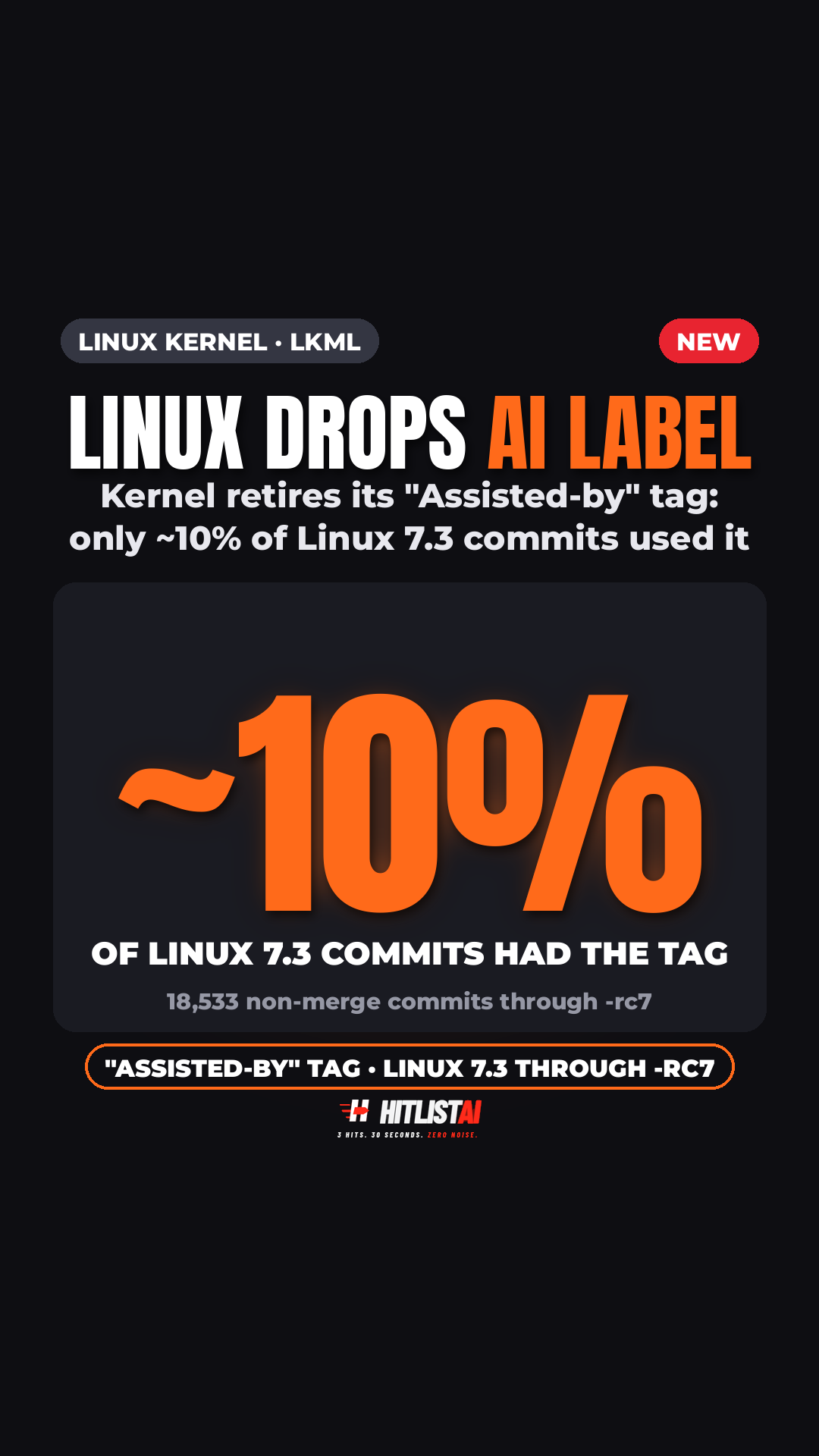 13Coding
Linux kernel drops its AI disclosure tag
Linux kernel maintainers removed the "Assisted-by" tag that asked contributors to label patches written with help from an LLM. Only about 10% of the 18,533 non-merge commits in Linux 7.3 (through -rc7) carried it, while actual LLM use is far more widespread: some contributors didn't know the rule, others left it off on purpose, and few maintainers asked, so a missing tag said nothing. The 2026 Maintainers Summit reached a "strong, though not unanimous" consensus to drop it, and docs maintainer Jonathan Corbet applied the patch to the kernel docs tree on Oct 14. Maintainers still want to know how a patch was made, now in the cover letter, and the DCO and submitter-responsibility rules stay. Linus Torvalds: "We're not going to make stupid rules that say 'you can't use tools for X'."
Linux kernel mailing list · lkml.iu.edu ↗ (opens in a new tab)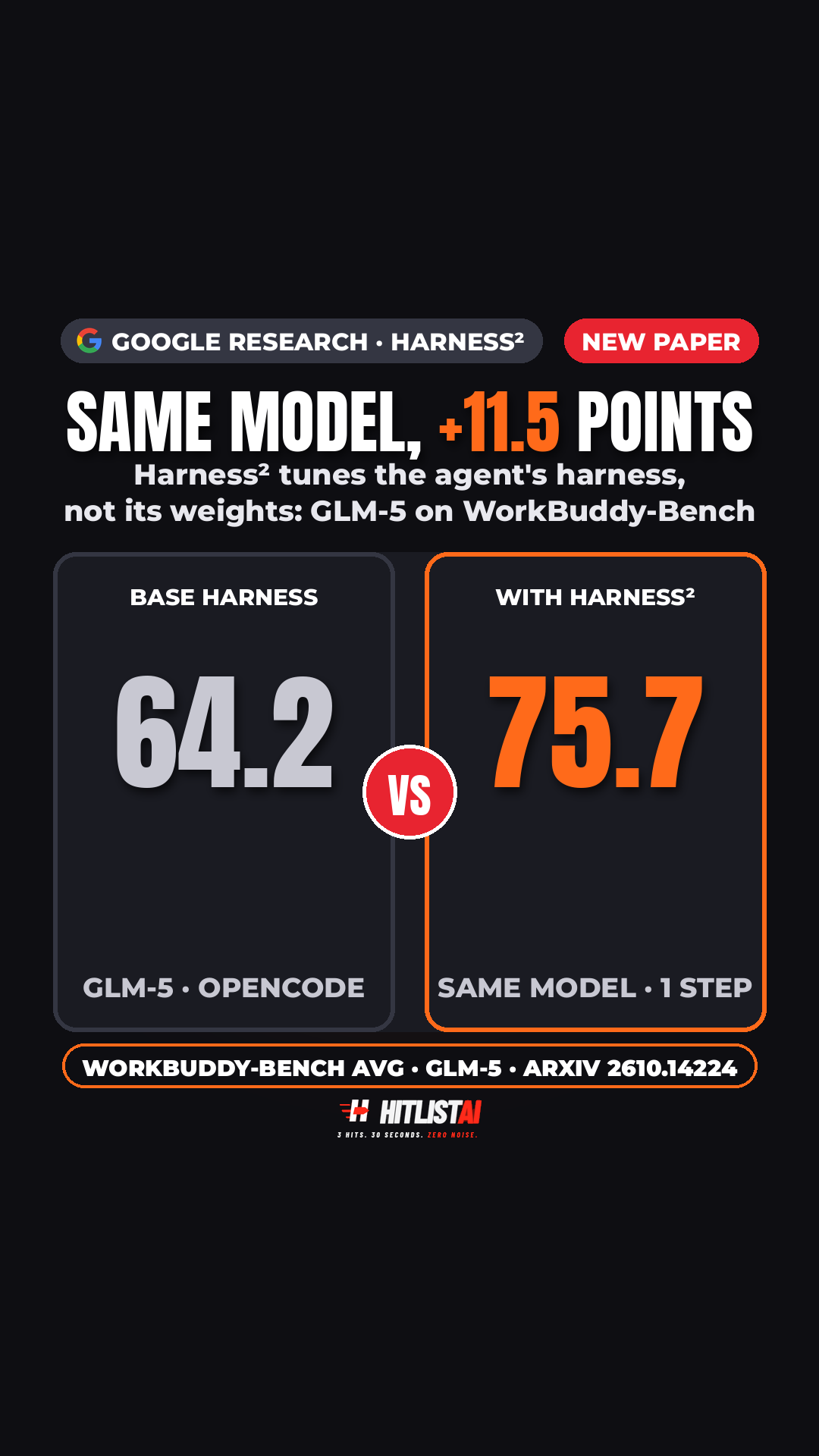 14Agents
Google's Harness² lifts GLM-5 by 11.5 points
Researchers at Google released Harness², which improves an AI agent by tuning the harness around a frozen model (its prompts, tools, memory and skills) instead of changing the weights. For each task it proposes a general and a domain-specific harness edit, probes both on the same task, and composes a better harness without ground-truth answers, saving lessons to a library for later tasks. On WorkBuddy-Bench one step lifted GLM-5 in OpenCode from 64.2 to 75.7, above base Gemini 3.5 Flash (72.4); gains reached 4.5 points on JobBench and 11.8 percentage points on Harvey's LAB. Caveats: Meta-Harness led on LAB for Gemini 3.5 Flash under Codex, and the extra probe runs add inference cost. Code is Apache 2.0 (arXiv 2610.14224, Oct 9, 2026).
arXiv (Harness²) · arxiv.org ↗ (opens in a new tab)