Post
28 Oct 2026
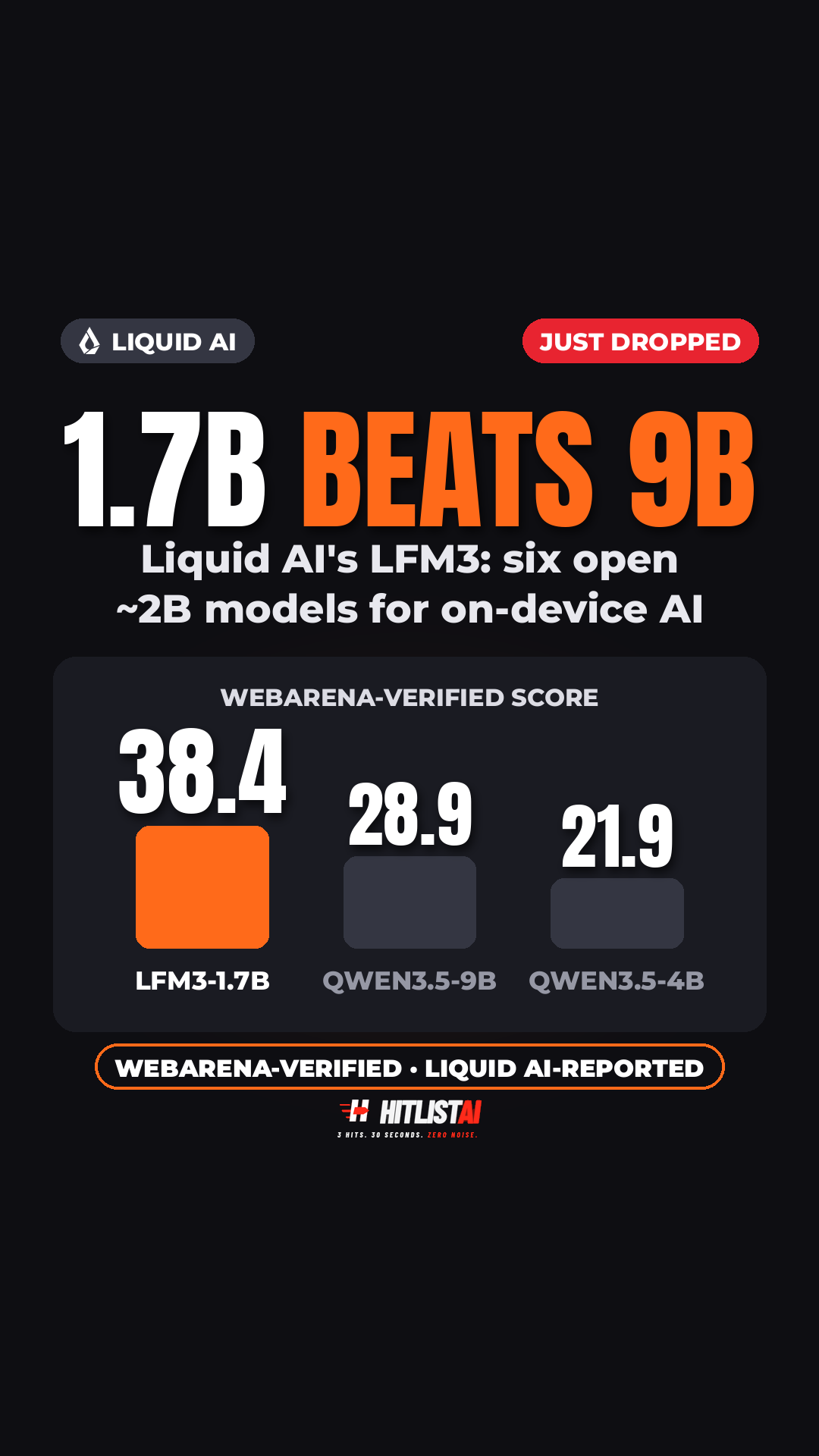
LFM3: Liquid AI's open 1.7B model beats a 9B on web agent tasks
Liquid AI announced LFM3 on 27 October 2026, a family of six open-weight on-device models in the 2B parameter range: four cover text, vision, audio and omni inputs, and two are decision models, all branched from the same LFM3-1.7B-Base backbone. In Liquid AI's own benchmarks, the LFM3-1.7B text model scores 38.42 on WebArena-Verified, ahead of Qwen3.5-9B at 28.94 and Qwen3.5-4B at 21.92. Liquid AI says the text model fits in about 1 GB at 4-bit precision and has a 256K-token context window, and that larger models still win on agentic coding and knowledge. Every model can be fine-tuned on a single GPU, and the open weights are available on Hugging Face, Liquid AI's Playground and its API. All benchmark numbers are self-reported by Liquid AI.
 02Research
Anthropic's Claude in drug discovery: early results from 6 partners
Anthropic said on 27 October 2026 that Claude is now working inside real drug development programs at six partners: BigHat Biosciences, Bristol Myers Squibb, Divergence Labs, Enveda, Generate Biomedicines and The Column Group. At Generate Biomedicines, a CAR T design proposed with Claude Code was about 70% shorter than the standard version and, in lab tests, let immune cells make roughly 10 times as many receptors. At Enveda, across 1,061 pages of manufacturing documents, Claude caught all 11 issues human reviewers had found and flagged 7 they missed, cutting human review time by 89% (from over 25 hours to under three). Anthropic also acquired Mithril Medicine, a one-person company working on two rare forms of muscular dystrophy, and says that if results hold, a drug could start human clinical trials as soon as late 2028. The work is still mostly preclinical, so the drugs are not yet being tested in humans.
anthropic.com · anthropic.com ↗ (opens in a new tab)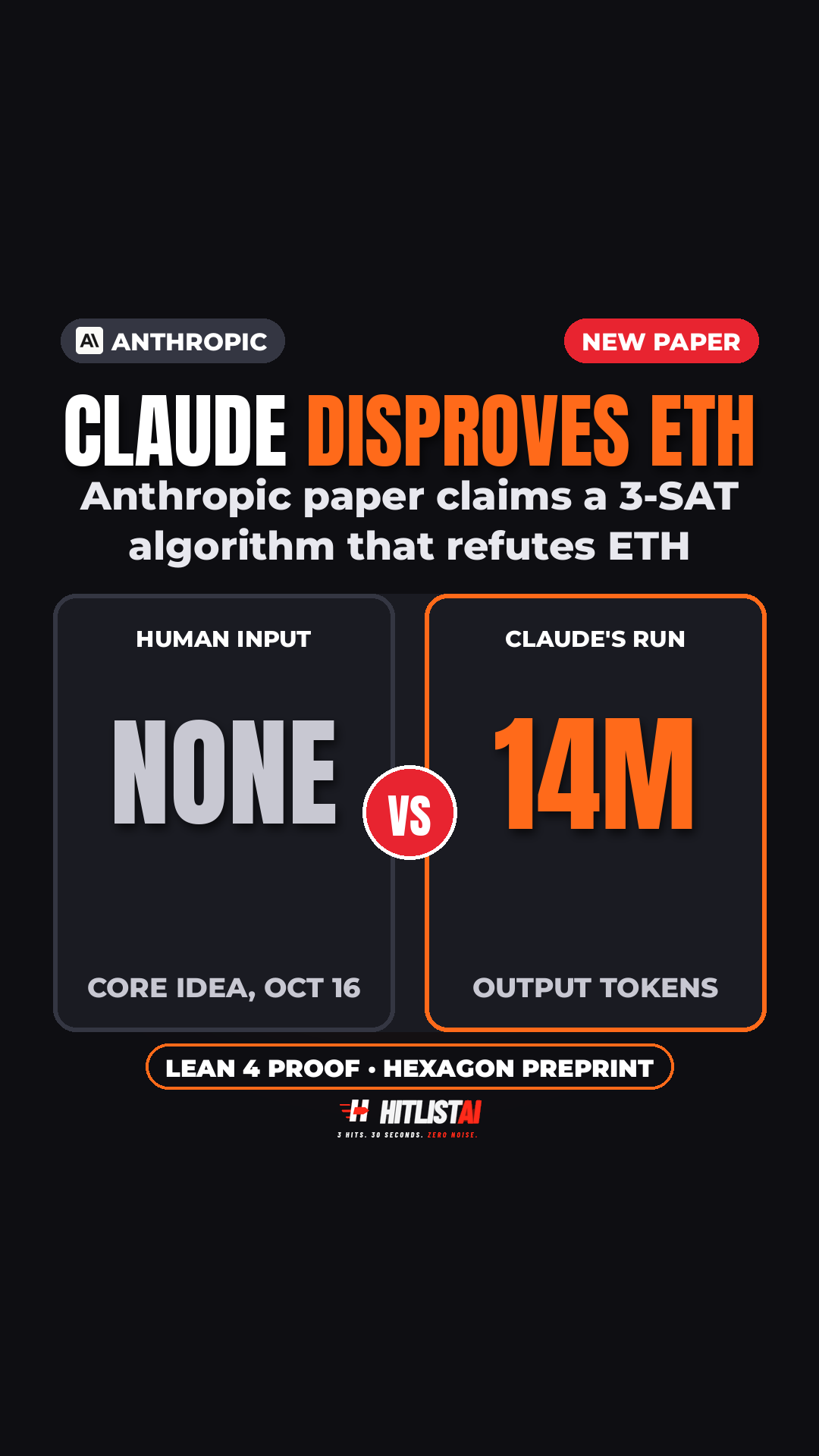 03Research
Claude disproves the Exponential Time Hypothesis, says Anthropic
Anthropic posted a preprint, "A 2^o(n) Time Algorithm for 3-SAT", credited to Claude and deposited on Hexagon on 27 October 2026. It claims a deterministic algorithm that solves 3-SAT on n variables in 2^o(n) time, refuting the Exponential Time Hypothesis (ETH) proposed by Impagliazzo and Paturi in 2001, and that also counts the satisfying assignments. Anthropic says the core algorithm was found on 16 October by an internal Claude research model using 14M output tokens and no human input, after which Anthropic researchers worked with Claude on the presentation. The Lean 4 formalization is public on GitHub, and the repository's CI re-checks the proofs with a second, independently written kernel. The result is purely asymptotic and says nothing about solving formulas faster in practice, it does not settle P vs NP, and the preprint is not yet peer reviewed. OpenAI separately claims a similar result.
hexagonmath.org · hexagonmath.org ↗ (opens in a new tab)